


The process of buying a home can be referred to as the American Dream, which may be quite distant to single mothers. Working, taking care of a child, and maintaining a house on a single income may seem too difficult to consider purchasing a house.
But the truth is, you can do it.
Single women are already quite powerful in the sphere of the housing market. The recent statistics indicate that single women possess approximately 2.7 million more homes than men in the United States. They also constitute approximately 17–19 per cent of the total homebuyers, and this demonstrates that you do not have to have a second income to afford a home. The mean American home is priced at approximately 417,000 dollars, although there exists state support and grants to assist low- to middle-income families to afford.
This manual will take you through every step, clarify any confusion, and make you confident by sharing practical home buying tips for single mothers in USA.
TL;DR – Home Buying Tips for Single Mothers in the USA
- Yes, single mothers can buy a home. Many already do.
- Banks don’t care if you are single — they look at your income and credit.
- Child support can count as income if you get it regularly.
- You can buy a home with little or no down payment using FHA, USDA, or VA loans.
- There are grants and help programs for first-time buyers.
- Try to keep your credit score above 620.
- Buy a home you can comfortably afford, not the most expensive one the bank allows.
- Get pre-approved before looking at houses.
- Always get a home inspection to avoid surprise repairs.
- A buyer’s agent helps you with price, paperwork, and safety.
Can Single Mothers Buy a Home in USA?
The short answer is: Yes.
Yes, single mothers can buy a home in USA, and many already do. Data shows that single women own about 2.7 million more homes than single men, which proves that women are actively buying property on their own. Single women also make up around 13% of all homeowners in the country. In many U.S. cities, the homeownership rate for single mothers ranges from about 22% to nearly 50%, depending on housing prices and income levels.
Banks do not look at your marital status when approving a mortgage — they care about your income, credit score, and ability to repay the loan, which makes homeownership very possible for single mothers with proper planning and support.
The Power of “One”
Single mothers are terrified that they will not have enough money to cover one paycheck. The lenders consider your debt-to-income ratio, which is merely how much you owe in comparison with the amount of money you earn. When you are good with your debts, then one income can be equivalent to two incomes with a lot of debt.
Stability Counts
Lenders like stability. In case you have worked in the same position for more than two years, then you are already an excellent candidate. Regularity can be of more value than a good salary to the lender.
Homeownership Challenges Single Mothers Face
You should be practical concerning those hurdles because you have to be ready.
The “Income Stretch”
The most apparent difficulty is the dependency on a single salary. In case the car fails or a child falls ill, the money is not provided as a backup salary. This tightens the loan issuance of the mortgage a notch tighter concerning the monthly cash flow.
The Time Squeeze
House hunting takes time. Single moms may find it tiresome to visit homes during school drop-offs and work between 8 and 10, and at bedtime. You do not even have a partner who could look around when you are working.
Decision Fatigue
Having the final say in making the decisions makes all the burden fall on you when you are the sole decision maker when selecting the right neighbourhood, the right school district and the right mortgage. This may result in stress and analysis paralysis.
Why Buying a Home is Still Achievable with the Right Programs and Planning

Nevertheless, thousands of single mothers foreclose homes each month. Here is the reason why you can, as well:
Specialised Loan Programs
Single-parent households require assistance, which is understood by the U.S. government and other non-profits. Loan programs with a minimum 0% to 3.5% down are available, and it is easier to begin.
Inclusive Income Sources
A mortgage can often be counted as child support and alimony. In case you can demonstrate that the payments are consistent (at least 6 months) and will further in the next three years, lenders can include this in your income to enable you to secure a bigger loan.
10 Step-By-Step Home Buying Tips for Single Mothers in USA.
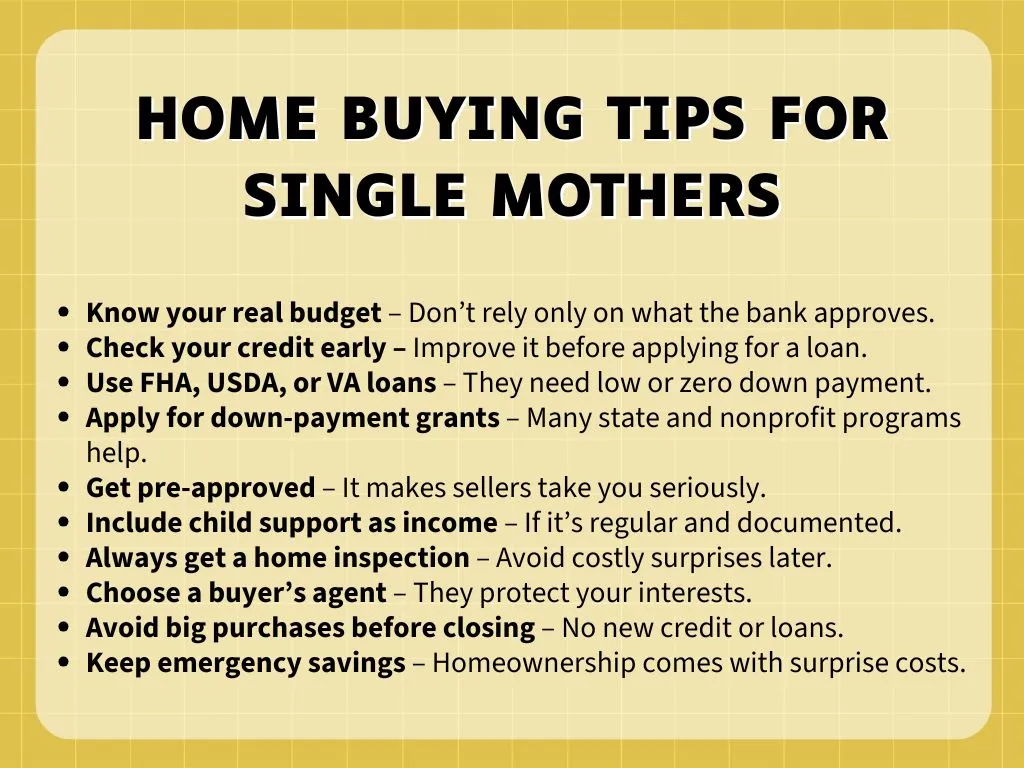
This is your roadmap. Do them one by one, not to be overwhelmed.
1. Check Your Credit Score
A credit score demonstrates the riskiness of lenders to loan you money.
Why it is important: The higher the score, the lower your interest rate, and thus, your monthly payment would be cheaper.
- What to do: Obtain a free credit report at websites such as AnnualCreditReport.com.
- The goal: Aim for a score above 620. There are FHA mortgages that require a score of 580 and below. In the event that you have a low score, pay off the balance due on credit cards within the next 3-6 months and then apply.
2. Set a Realistic Budget
Do not believe what the bank can tell you you can afford. The bank does not know that you pay for daycare, piano lessons, or emergency medical bills.
- The 28 per cent Rule: Your monthly payment (tax and insurance included) on your mortgage must not exceed 28 per cent of your gross monthly income.
- The Sleep Well Number: This is a payment that helps you to sleep at night without any money worries. When such a number is less than the one the bank has given permission, then use your number.
3. Get Ready: First-Time Buyer Programs.
You do not need a 20% down payment. Those who are first-time buyers deposit significantly less.
- Fannie Mae HomeReady: A standard mortgage loan to low-income earners. It needs only a 3 per cent down payment and allows you to use the income of other members of the household (such as a parent who is living with you) to qualify.
- Freddie Mac Home Possible®: This program provides the same benefits as HomeReady, such as 3% down payment and reduced mortgage insurance premiums, particularly where the buyer is located in an underserved community.
4. Apply for Government Loans
Single mothers usually benefit from government-sponsored lending since they have lower credit scores and require low down payments.
FHA loans are federally insured loans and have a required down payment of 3.5 per cent. Their characteristics are very popular due to their easy credit requirements.
- USDA Loans: U.S.DA loans are available to those who would like to live in a suburban or rural setting (some rural settings are near a town). These need 0% down.
- VA Loans: This is the best loan to take in case you are a veteran or a surviving spouse of a veteran. It has 0-down and no mortgage insurance.
5. Save for Down Payment and Emergencies.
Although you can afford to pay only a low down payment, you must still have money to cover the closing costs (lawyers, title companies’ fees, etc.) and an emergency fund.
- Strategies such as automatically transferring to a savings account at the end of each payday. Even $50 helps.
- Find IDAs: Individual Development Accounts are special savings accounts of low-income individuals in which non-profits match your savings. They could give you a home dollar or two or three, as a reward for every dollar you save.
6. Get Pre-Approved for a Mortgage.
There is a huge distinction between pre-qualified and pre-approved.
Pre-qualification is an approximate figure.
- Pre-approval: It is an assurance of a loan given by the bank.
- Why do it: Without a pre-approval letter, a seller is not going to take your offer seriously. It displays the fact that you are willing to spend the money.
7. Apply Reliable Home-Search Utility.
To save time, you need to find good tools when you are ready to look.
- Zillow & Redfin: These are good for window-shopping and checking the ratings of schools.
- Realtor.com: Can have the most current information directly out of the MLS (Multiple Listing Service).
- HUD.gov: The HUD department enlists HUD Homes. They are foreclosures that are sold at a discounted price, and when families intend to occupy them, they take preference over investors.
8. Request Grants and Nonprofit Assistance.
Freemoney is there, where you know where to get it.
Several organisations provide free legal assistance to individuals, particularly those with low or no income. Numerous organisations offer free legal aid to people, especially low or no-income people.
- Key Services: NACA provides what is deemed the best mortgage in America. They offer mortgages without down payments, no closing charges, and no individual mortgage insurance.
- Description: They will check not only your credit score but also your character (rental payment history). It will need a workshop, yet the paybacks are enormous.
Habitat for Humanity:
- Significant Services: They construct affordable housing for the families who need it.
- Description: It is not a free house, but rather you purchase it with a cheap mortgage. You don’t pay cash down. You can also volunteer some of your time, known as sweat equity, to work on your house or that of others.
9. Never Skip a Home Inspection
Being a single mother, the last thing you want is a roof repair of $10,000, which was not expected two months after the house was bought.
- Rule: Make sure that you employ a licensed home installer.
- Cost: It ranges between $300 and $500, yet it can save you thousands. In case the inspector discovers significant issues, the seller can be requested to repair or reduce the price. You may walk off in case they decline.
10. Work With a Buyer’s Agent
It is essential to note: The payout of commission is not your payout.
- Why you need one: In the role of a buyer, the agent serves the interests of their client. They bargain out the price, do the paperwork, and save you from bad bargains.
- Identify a specialist: identify an agent who has earned the ABR (Accredited Buyer’s Representative) or has worked with first-time buyers and down payment assistance programs.
Common Mistakes Single Mothers Should Avoid
The Top Ten Things Single Mothers Should Not Do.
The thrill of home purchasing may lead to blindness at times. A single income earner has a smaller margin of error when doing this than a couple who are both earning incomes. The second salary can be used by the couple in order to cushion an error by a dual-income couple. Being a single mother, you are the CEO, CFO, and the primary investor of your household. It is a big burden of responsibility, and therefore, care should be taken.
You should learn about the pitfalls that can easily trap first-time buyers in order to save yourself and your children. The following are the most crucial errors, as explained in simple terms.
1. Getting to be House Poor (Maxing Out Your Budget)
This is the most common trap. When a lender pre-qualifies you to take a loan, he/she provide you with a limit- say, 350,000. One is tempted to seek homes of an exact price of 350,000.
- Error: Making a purchase at the highest limit.
- Fact check: The bottom limit is pegged on gross income (tax-free), and not what you take home. It does not cover your $200 in diapers, summer camp, and rising grocery costs. When your mortgage payments are 40 -50 per cent of your monthly income, then you are house poor. You can sleep under a roof, but you are stressed whenever you have to find new shoes for the kids.
- Fix: Purchase a house that is not as expensive as what the bank claims you can afford. Give yourself some breathing space.
2. Miscalculating the Habitual Costs of Ownership.
With renting, the landlord has the problem of a broken dishwasher. When you own it, it’s yours. Most single mothers only add the mortgage debt and repayment, and forget the unspoken expenses attached to the keys.
- The Mistake: Budgeting the monthly payment of the loan only.
- The Fact: You will also be required to pay property taxes, home insurance, and HOA fees. And you ought to put some money back in case of unforeseen repairs. A broken water heater may cost $1,000, and an AC may cost $4,000 in July.
- The Solution: The easiest way out is to save 1 per cent of the home value annually in terms of maintenance. To a house worth 200,000 dollars, or 2,000 USD per annum, or 166 USD per month.
3. Falling in love with the Fixer-Upper Fantasy.
We are all familiar with the renovation programs on how a couple manages to convert the shattered house into a beautiful home within a weekend. It seems fun and easy.
- The Mistake: Purchasing a home that requires much renovation to reduce expenses.
- The Fact: To one mother, a fixer-upper can turn out to be a nightmare. Time to sand floors when you have a toddler? Do you have the additional funds to employ contractors in case the plumbing is not as good as you imagined? Renovation projects are nearly always more expensive and time-consuming than anticipated. It is highly stressed to live in a construction area in the presence of children.
- The Solution: Purchase a turnkey house that is ready. This might seem slightly expensive at this point, but it will save you the stress and unexpected expenses in the future.
4. Purchasing Big Before the Closing.
It is an error that occurs more than you believe. You get a house, your bid is accepted, and you are nearly on the keys. You purchase a new bedroom set on credit at the store, and you are excited.
- The Faux Pas: Accepting new credit or making purchases on a large scale when the sale is still in escrow.
- The Veracity: Just before your lender makes a closing, he/she recredit you once again. When they notice that you are going to incur more debt of $2,000 on a sofa, this will alter your debt-to-income ratio, and it might end up denying your loan days for your move-in.
- The Fix: Freeze spending. Provisions: Buy furniture, rent a car, and co-sign loans before you get the key to the house.
5. Omission of Home Inspection.
In the competitive market, you may be compelled to forego the inspection in order to make your offer appear more favourable.
- The Error: Purchasing the house in its current condition without the services of a professional inspector.
- The Reality: It may seem that a house is ideal, but there may be something wrong with it, such as an infestation of termites, or mould in the attic, or a broken foundation. The cost of repairs is tens of thousands of dollars, which is beyond the ability of many families with a single income earner.
- The Solution: Do not miss the inspection. It is worth every cent of the 400 dollars. In case it has significant issues, you can back out, which will spare you financial devastation.
Conclusion
You are daring to acquire a home that is a good investment for your family as a single mother. It provides stability to your children and creates your wealth.
It may take a long and tedious process that involves paperwork. However, keep in mind that this has been done by millions of single women. With the right weapons, FHA loans, down-payment grants, and an agent you can rely on, you are able to turn that key and say, “This is ours.”
You are not just creating a house, you are creating a home—and these home buying tips for single mothers in USA are designed to help you do it with confidence.
FAQs
1. Will child support help me get a mortgage?
Yes. In case you could demonstrate that you have been getting it for at least 6 months and will continue to get it for at least 3 more years.
2. What is the amount of the down payment required?
The average single mother will require 0% (USDA/VA loans) to 3.5% (FHA loans) of the price of the purchase.
3. What credit score do I need?
The standard safe score is 620; however, FHA loans will allow a score below 580, provided you deposit an increased amount of money.
4. Do single mothers have any grants?
Single-mother-specific grants are not numerous, but there are several low-income and first-time buyer grants that single mothers may apply for. See the Housing Finance Agency Web page in your state.