

The Delhi Mumbai expressway route map is the most ambitious new road in India, which provides a connection between the capital and the financial hub. It spans approximately 1,386km and it reduces travelling time radically. The road transports more than 85,000 vehicles on a daily basis by February 2026. Cost of the project was approximately ₹98,000 crore and it has 8 lanes which can be expanded to 12. The speed limit is 120 km/h. It operates in Delhi, Haryana, Rajasthan and Gujarat.
There are 94 accesses, 178 bridges and 8 multi-layer exchanges in the Delhi Mumbai expressway route map. About 97 % was finished by early 2026. It has now reduced the time it was 24 hours between Delhi and Mumbai to only 12, which assists the economy and logistics. It is the longest new greenfield expressway in India which was constructed to facilitate easy journey between two big cities. It passes over Haryana, Rajasthan, Madhya Pradesh, Gujarat and consequently Maharashtra.
The highway is formally named National Expressway3 (NE-3). It is packed with safety and high tech traffic control. The design speed is 120 km/h. It manages about 150,000 passenger cars on a daily basis. It has 4 tunnels and the route spans 8 districts, which links industry and agriculture.
What is the Delhi‑Mumbai Expressway?
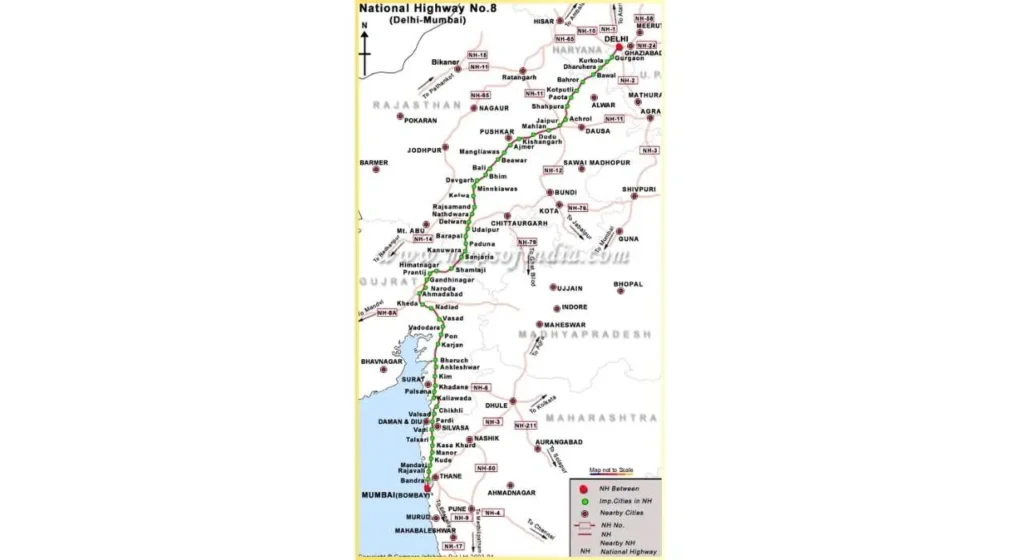
Traffic is maintained by the Delhi Mumbai expressway route map having entry and exit points that are strategically located with more 52 points currently open and additional 12 planned to open in mid-2026.
Sohna (Haryana), Dausa (Rajasthan) and Vadodara (Gujarat) have major exchanges, which have toll plazas and FASTag. Exits are spaced 25–30 km apart. Service roads cut to 420km at strategic points allowing traffic within the local areas to pass without backing up the main traffic. There are electronic signs indicating exits, and there are 78 digital boards indicating real-time information.
Delhi–Mumbai Expressway Route — Key Overview (2026)
| Attribute | Detail |
|---|---|
| Official Name | National Expressway-3 (NE-3) |
| Total Length | ~1,386 km |
| Operational Status (Feb 2026) | ~97 % Open (~1,345 km) |
| Expected Full Opening | June 2026 |
| Major States Covered | Delhi, Haryana, Rajasthan, Madhya Pradesh, Gujarat, Maharashtra |
| Design Speed Limit | 120 km/h |
| Number of Lanes | 8 lanes (expandable to 12) |
| Daily Traffic (Feb 2026) | ~85,000–150,000 vehicles/day |
| Total Cost | ~₹98,000 crore |
| Toll Plazas | 8 (FASTag active) |
| Rest Stops | 42 (spaced ~50–60 km) |
| Safety & Tech Features | 340 CCTV, digital boards, weather sensors |
| Major Interchanges | Sohna (HR), Dausa (RJ), Vadodara (GJ) |
| Service Roads | ~420 km |
| Tunnels | 4 |
| Wildlife Crossings (Package 7) | 2 |
Delhi‑Mumbai Expressway Complete Route Map (State‑Wise Breakdown)
| State | Entry Point | Exit Point | Distance (km) | Major Cities/Towns Covered |
| Delhi | Dwarka Expressway Junction | Delhi-Haryana Border | 22 | Dwarka, Najafgarh |
| Haryana | Delhi Border | Shahjahanpur-Neemrana Border | 98 | Gurugram, Rewari, Shahjahanpur |
| Rajasthan | Neemrana | Ratlam Border | 373 | Alwar, Dausa, Lalsot, Bundi, Kota |
| Madhya Pradesh | Ratlam Entry | Agar-Malwa Border | 244 | Ratlam, Agar, Shajapur, Dewas |
| Gujarat | Godhra | Vadodara | 426 | Godhra, Halol, Vadodara, Ankleshwar, Surat |
| Maharashtra | Manor | Jawaharlal Nehru Port | 223 | Palghar, Virar, Thane, Mumbai |
Entry & Exit Points Across the Expressway
The Delhi Mumbai expressway route map is designed such that the entrances and exits are in good places to ensure the flow of traffic is smooth. There are currently 52 operational controlled exits and 12 more will be opened by mid 2026.
Robust crossroads occur at Sohna in Haryana, Dausa in Rajasthan and Vadodara in Gujarat. They both have fast tag lanes and toll booths. The spacing of exits is about 25 30km. Service roads in major locations extend to 420km without congesting traffic. There are digital signs that show drivers their way to exits and the real-time updates on 78 boards.
Major Entry & Exit Points (State-Wise)
| State | Major Entry Point | Major Exit Point | Key Interchanges / Access Points |
|---|---|---|---|
| Delhi | Dwarka Expressway Junction | Delhi–Haryana Border | Dwarka, Najafgarh Link |
| Haryana | Sohna | Shahjahanpur–Neemrana Border | Gurugram, Rewari Interchange |
| Rajasthan | Neemrana | Ratlam Border | Alwar, Dausa, Lalsot, Bundi, Kota |
| Madhya Pradesh | Ratlam Entry | Agar–Malwa Border | Ratlam, Shajapur, Dewas |
| Gujarat | Godhra | Vadodara | Halol, Vadodara Interchange, Bharuch/Ankleshwar |
| Maharashtra | Manor | Jawaharlal Nehru Port (JNPT), Mumbai | Palghar, Virar, Thane |
Estimated Toll Charges (Delhi → Mumbai)
| Vehicle Type | Estimated Toll Cost (One-Way) | Notes / Basis |
|---|---|---|
| Car / Jeep / SUV (Private) | ₹2,000 – ₹2,950 | Based on per-km rate ~₹1.5–₹2.19/km for the full stretch. |
| Light Commercial Vehicle (LCV) | ₹3,200 – ₹4,000 | Higher per-km rate (₹2.4 – ₹3.0). |
| Bus / Truck (2-Axle) | ₹6,700 – ₹8,100 | Approx. ~₹5.0 – ₹6.0/km. |
| Multi-Axle Vehicle (3+ Axle) | ₹10,000 – ₹13,500 | Approx. ~₹7.5 – ₹10.0/km. |
| Very Heavy Commercial (Large Trailers) | ₹15,000 + | Varies widely with axles & weight. |
Expressway Operational Status (2026)
Is it open yet?
By February 2026, Delhi Mumbai expressway route map should be open on the majority of the road. People can drive unstopped over a distance of 1, 345 km which constitutes 97 percent of the entire distance.
The Delhi-Dausa section (364km) has been operational since June 2023. Vadodara223 km (223 km) Mumbai- Vadodara In stages 2024-2025. As of today, the open parts are used by a group of approximately 92, 000 vehicles on a daily basis. Sohna and Dausa have been found to be popular with a 34 percent growth in traffic between Jan 2025 and Feb 2026.
Expected Full Opening
The remaining section of the Delhi Mumbai expressway route map ought to be completed by June 2026. The 41-km route between Ratlam and Agar- Malwa in Madhya Pradesh is included in package 7.
Authorities intend to do a test run in April 2026 and subsequent safety inspections on approval. By December 2026, the road will be able to accommodate 180,000 cars once it is complete. NHAI estimates that all 8 toll booths will be functional and FASTag lanes would require less than 10 seconds to handle each car. The all-year-round roads are going to be maintained safe by weather sensors of 126 sites.
Travel Time & Distance
The Delhi Mumbai expressway route map shortens the travelling time that was estimated at 24 hours to 12 only by half. It can be a daily journey of the 1,386 kms with rest breaks.
Average driving speed 100-110 km/h consumes less fuel than because of old roads (up to 18 percent). It has 42 rest positions at the distance of 50-60 km which provide the fuel, food and rest. The Delhi- Jaipur leg would take approximately 2.5 hours and Delhi- Vadodara approximately 8 hours. This is an advantage to both travelers and delivery trucks.
Package 7 & Construction Details
The final Delhi Mumbai expressway route map 41km stretch between Ratlam and Agar-Malwa is known as package 7. It was constructed at a cost of 4, 200 crore and in it, there are 6 bridges and 14 underpasses through challenging terrain.
As of Feb 2026, Package 7 is 94% done. Road surface work is yet to be completed. It contains 2 wildlife corridors and drainage especially against the monsoon rain. Asphalt used was over 3, 200 workers and 2.8 lakh tonnes. Its completion will make the road extended between Delhi and Mumbai. The surface remains smooth and to international standards after quality checks that are done automatically by use of automatic systems.
How Many Lanes Are There?
The Delhi Mumbai expressway route map will be predominantly 8 lanes although this will later be increased to 12 lanes. The route of Delhi -Vadodara is 8 lanes (4 in both directions) and the lanes are 3.75 meters (global highway specifications).
The roadway has 10 lanes towards Delhi and Mumbai to deal with high traffic allowing approximately 200,000 vehicles daily. It has 1.5 meters shoulders on both sides that are automatically monitored by 340 CCTV cameras which are used in case of an emergency. It has a 5-crate median with the crash barriers and plants to avoid vehicles entering the oncoming traffic.
Total Travel Cost Estimation
| Cost Component | Car (Petrol) | Car (Diesel) | Bus/Truck (Commercial) |
|---|---|---|---|
| Toll Charges (One-Way) | ₹2,000 – ₹2,950* | ₹2,000 – ₹2,950* | ₹6,700 – ₹8,100* |
| Fuel Cost (One-Way) | ₹6,750 – ₹8,100** | ₹4,750 – ₹6,400** | – |
| Food & Refreshments | ₹800 – ₹1,200 | ₹800 – ₹1,200 | ₹1,200 – ₹1,800 |
| Rest Stop Snacks/Breaks | ₹300 – ₹500 | ₹300 – ₹500 | ₹500 – ₹800 |
| Total Estimated Cost | ₹9,850 – ₹12,750 | ₹7,850 – ₹11,050 | ₹8,400 – ₹10,700 |
Navigation & Google Maps Tips
To use Delhi Mumbai expressway route map, you require the latest digital resources and familiarity with the latest traffic. Larger navigation applications like Google Maps, Apple Maps, and Indian MapMyIndia provide the right directions and real-time traffic flow in the 1,386-kilometer path in 2026.
Find your way right: formally enter the names of a new Delhi Mumbai Expressway into your navigation software: enter either Delhi Mumbai Expressway or NE-3 in search and you will have the correct road.
Switch on live traffic: you need the app to display live traffic because you will then receive notifications about jams, accidents, or construction. The traffic update is available at 420 checkpoints every 3-5 minutes.
Save offline maps: downloaded maps will be saved in time before leaving. The mobile signal may be lost in certain areas of Rajasthan and Madhya Pradesh with approximately 18 percent of road being affected.
Add favourites: Add all significant fuel stations, rest stops, and toll plazas to your favourites in your app particularly the 42 side facilities, which are spaced approximately 50-60 kilometres.
Check alternative routes: survey other alternative roads prior to the beginning of your travel, particularly during monsoon seasons (July 6 September), wherein approximately 6% of the roads could have weather warning signs or speed restrictions.
Conclusion
The Delhi Mumbai expressway route map illustrates a massive infrastructure victory that actually transforms the commuting between the political and monetary centres of India. It travels 1,386 kilometres and traverses six states and was 97 percent complete in February 2026. It is not going to break its word concerning shorter travel times, improved safety, and more economical growth.
It takes approximately 12 hours to travel from Delhi to Mumbai, half the time of the former routes. This road has 8 lanes, which can be increased to 12 lanes in the future to accommodate increased traffic. It has got 42 rest stops, 340 CCTV cameras, and 28 emergency teams, hence it is not only concerned with speed but also with comfort and safety.
Also Read:
FAQs
What is the total distance covered by the Delhi Mumbai Expressway in 2026?
It runs a distance of approximately 1,386 kilometres and connects Delhi to Mumbai, passing through Haryana, Rajasthan, Madhya Pradesh, Gujarat, and Maharashtra. It was 97% finished.
How much time does it take to travel from Delhi to Mumbai via the expressway?
Approximately, it requires 12 hours when you drive 100-110 km/h. That is twice the speed of the former 24 hrs route.
Is the Delhi Mumbai Expressway fully open for traffic currently?
As of February 2026, 1,345 kilometres (97 percent) were operational. The final 41 ‑ kilometre in Madhya Pradesh is due to open by June 2026.
What vehicles are allowed on the Delhi Mumbai Expressway?
Cars, buses, as well as commercial trucks with a FASTag are permitted. The forbidden vehicles are motorcycles, which have less than 125cc, tractors, carts, which are pulled by animals, and very slow vehicles due to their safety measures.
How many toll plazas are there on the Delhi Mumbai Expressway route?
The road has 8 major toll plazas. FASTag is mandatory, and the mean price at any given moment of the toll car was approximately 2.65 per kilometre.