

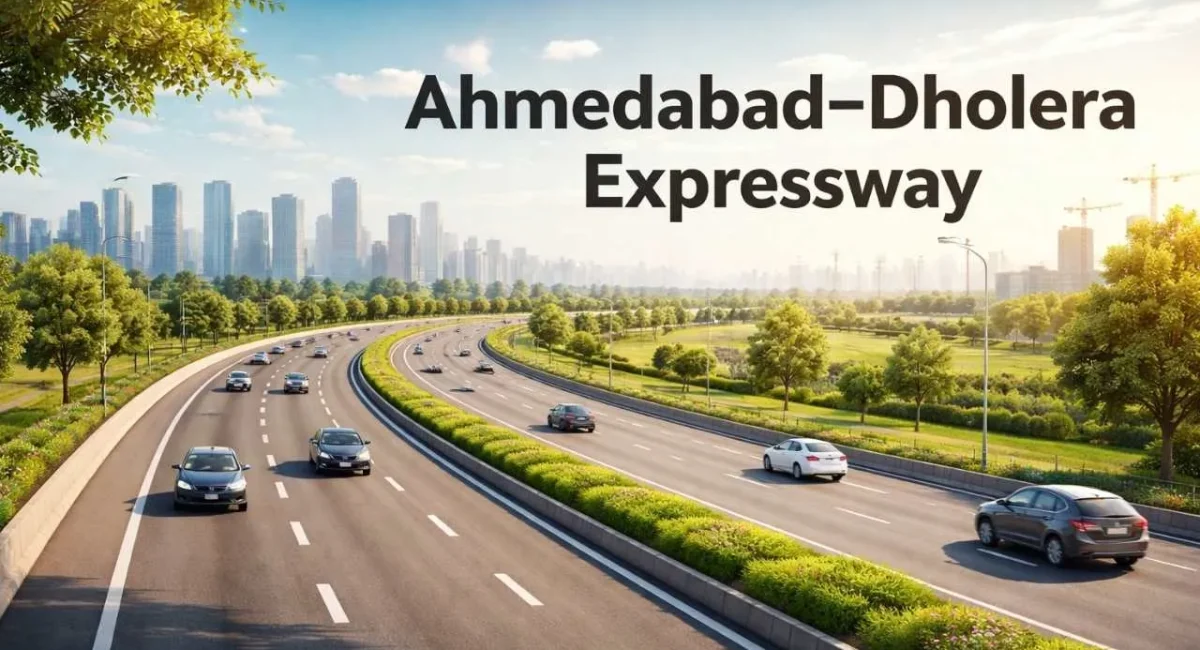
One of the largest infrastructure jumps in decades is happening in Gujarat. The Ahmedabad Dholera Expressway is a 109km green field, access-controlled expressway connecting Sarkhej to Ahmedabad, passing directly through the centre of Dholera Special Investment Region (SIR). This is a high speed route, which is included in the Delhi-Mumbai Industrial Corridor (DMIC) and is constructed under the scheme of Bharatmala Pariyojana.
The project has an estimated construction cost of 3196 crore (excluding land costs), and the investment in the project, inclusive of related infrastructure, is estimated to be in the range of 4300-4500 crore. This corridor, which is already in progress, has already begun to transform the way people and businesses think about southern Gujarat with almost 98 percent of the work already completed by the beginning of the year 2026.
The Prime Minister of India launched the expressway on 23 February 2026 -the date that will be remembered as a landmark to the development of Dholera. Instead of the previous 2.5-hour journey, it will now take only 40-45 minutes as India first greenfield smart city is bound with the prospering commercial eco system of Ahmedabad. The Ahmedabad Dholera Expressway is not a mere road — it is an opening to the future of Gujarat.
Why Ahmedabad–Dholera Expressway Matters in 2026
The future industrial map of India is moving to the south towards Dholera SIR, and the Dholera Expressway in Ahmedabad is the main cause of such a change. The area marks the immediate entry point to Dholera Smart City where the Tata Group ₹91,000 crore semiconductor manufacturing plant (one of the largest manufacturing investments in Indian history) is located.
It is an expressway designed with the capacity to accommodate up to 25,000 vehicles in a day and with a top speed of 120 km/h; the purpose of this expressway is to accommodate industrial logistics and day to day commuters. It connects Ahmedabad city economy with the industrial goals of Dholera in the span of only 109 km, which makes movement more affordable, efficient, and dependable every day.
Project Overview & Key Highlights
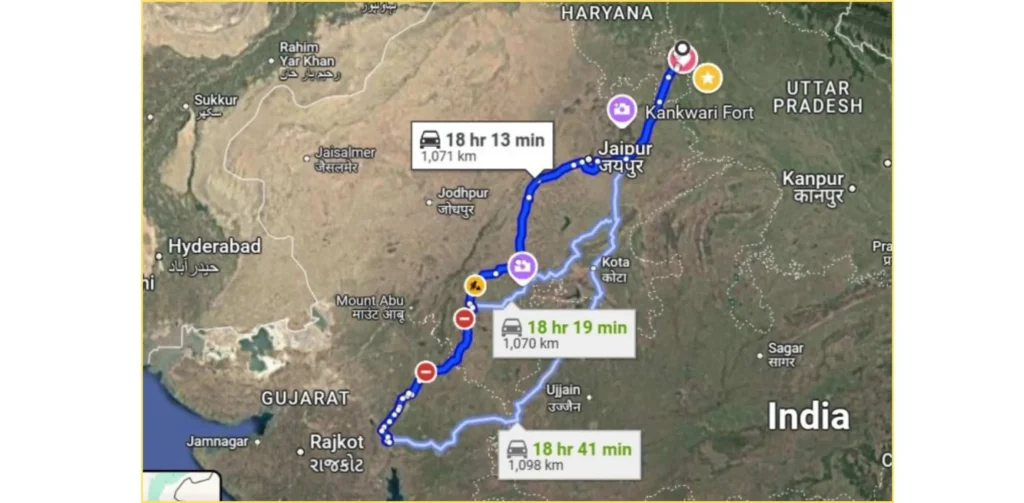
The dholera expressway is a four-lane road (which can be expanded to 12 lanes in the future) named as NH-751. It was constructed on an Engineering, Procurement and Construction (EPC) model, with 8 major interchanges, 2 railway overbridges of major freight paths and road side facilities every approximately 50km containing rest areas, emergency medical posts and fuel stations.
The scale and ambition of this project is what makes it unique in 2026. It is planned to accommodate 25,000 vehicles per day, and will utilise recycled materials such as 2035 lakh m 3 of Pirana landfill waste, approximately 1.7 crore m 3 of fly ash in the earthwork and it will have direct accessibility to the future Dholera International Airport through a link road span of 9.56 km at Pipli Junction.
Explore: Surat Chennai Expressway Route
Ahmedabad Dholera Expressway Inauguration Date
The Ahmedabad Dholera Expressway was launched on 23 February 2026, in the presence of the Prime Minister of India and other senior government officials. This was a ceremonial inauguration of the most strategic Indian greenfield expressway.
The bridge construction, even before the project was set up, is scheduled to be over the Western Dedicated Freight Corridor and Bhavnagar railway lines, and the ramp, close to Tajpur village in Sanand, has been stalling the project since it was first planned to start in October 2025.
By the day of the inauguration, 98% of the construction had been completed, and the remaining finishing was underway at the same time.
The corridor acquisition was made as early as July 2020, and the contracts to build it were awarded to Sadbhav Engineering, GHV India, and DRA Infrastructure in November 2020, so the project took almost 5 years to build after the groundbreaking ceremony.
Also Read: Top Builders in Ahmedabad
Ahmedabad Dholera Expressway Route Map & Alignment
The Dholera Expressway originates at the Sarkhej, located at the southern periphery of Ahmedabad, on the Sardar Patel Ring Road. It passes southwards through industrial and semi-urban areas in accordance with the course of NH-8, SH-4 and SH-6 and runs along the seaside of the Sabarmati River until it reaches the border of Dholera SIR and ends in Adhelai village of Bhavnagar district.
The expressway on this alignment cuts over or through various major geographic and industrial landmarks with the next Dholera International Airport near Navagam (around 20 km to the Dholera SIR core). It is the Dholera Special Investment Region backbone and residential and industrial development in the SIR territory is supported by it.
Route Breakdown
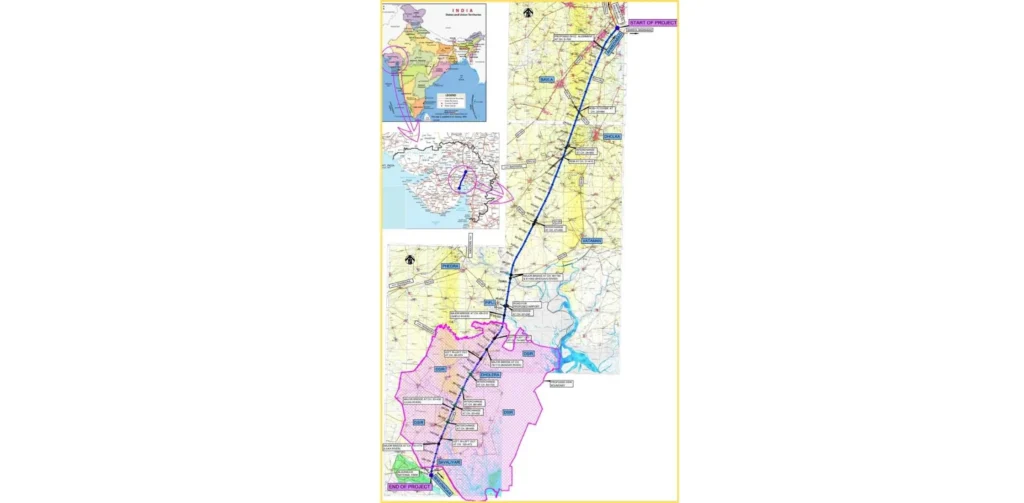
The NHAI has split the 109 km highway into four construction packages:
- Package 1 – This is by starting Sarkhej (SP Ring Road) and finishing close to Sindhrej village. Has the Sarkhej Interchange (Diamond type) between SP Ring Road and NH-8A.
- Package 2 – This one passes through the centre of the major industrial areas, and it interchanges at Dholera Activation Area and other areas.
- Package 3 – It has the Pipli Junction exchange that has direct access to the 9.56 km road with a link road to the Dholera international airport.
- Package 4 – This is the last to conclude at Adhelai village, outside Bhavnagar, at the end of the expressway.
The design combines 8 interchanges totaling 4.5 miles, including Diamond, Cloverleaf, and Butterfly Circle, ensuring that at all major intersections, there are grade-separated access points that do not disrupt traffic signals.
Ahmedabad–Dholera Expressway Distance & Travel Time
The overall length of the Ahmedabad Dholera Expressway measures 109km (108km, as some sources give the figure as 108km because it is rounded off). The distance between Ahmedabad and Dholera by conventional state highways could equally take about the same time as the expressway, only that the travel time could vary between 2 to 2.5 hours as a result of road congestion, crossroads, and the single-carriageway road sections.
This has been reduced to approximately 4045 minutes since the expressway began operating, saving over 1.52 hours per trip. This is an immense saving in logistics costs and time for industrial freight movement, which has hitherto been hampered by poor road quality and low speeds.
Speed Limit & Safety Features
Its expressway has a top speed of 120 km/h, and thus it is one of the highest-speed road corridors in Gujarat. The design has safety features built in, including:
- Emergency telecommunication points are installed regularly.
- Medical assistance is found at the rate of about 50 km.
- Lighting on the streets in completely finished parts.
- Heavy vehicle parking lay-bys.
- The full alignment of service roads to the local access.
- Separate interchanges at every major intersection to remove at-grade conflicts.
Ahmedabad–Dholera Expressway Toll Charges (Expected)
By 2026, the Ahmedabad Dholera Expressway should have toll plazas operating at strategic entry and exit. Plaza 1: Plaza 1 is structurally complete with utility buildings, fee booths and signage.
Official toll rates are not implemented officially in the open market yet before the inauguration date. Nevertheless, according to the standard rate cards of similar expressways offered by NHAI in Gujarat and the overall project cost of 4300-4500 crore, it is estimated by analysts that:
- Cars/ light vehicles: 80-120 per way trip.
- Mini buses /vans: 130-180 per one way.
- Trucks/heavy vehicle: ₹250- 350 and above 1 way trip.
These estimates are made in similar NHAI toll bases and can be different to the published rates in the end. This expressway is likely to be collected using the electronic system based on the FASTag as per the national policy of India.
Entry & Exit Points
The controlled access is provided by the Ahmedabad Dholera Expressway, which features 8 interchanges. The major entry and exit points are:
- Sarkhej (Ahmedabad)- Main north entrance through SP Ring Road.
- Pipli Junction-About 9.56 km linked road to Dholera International Airport.
- Vataman (Vejalka) — full exchange of toll infrastructure.
- Dholera Activation Area — SIR early industrial and residential areas exchange.
- Adhelai (Bhavnagar district) — The Southern end of the expressway.
- Adhelai (Bhavnagar district) — Southern terminal point of the expressway
Latest Ahmedabad Dholera Expressway Update (2026)
On 23 February 2026, the Ahmedabad Dholera Expressway was opened, marking the end of many years of construction under the Bharatmala Pariyojana. By the opening date, 98 percent of the construction work was already finished, and two railway overbridges, one over the Western Dedicated Freight Corridor and one over the Bhavnagar railway line, are almost finished with the remaining ramp works.
The successful removal of a 66kV GETCO substation at the village of Juval Rupavati (approximately 25 km south of Ahmedabad) that had been a cause of delay in that area was one of the greatest pre-inauguration breakthroughs. Bitumen laying and retaining wall work were done on that stretch after it was cleared, eliminating the final significant structural bottleneck.
There has been reported growth in property prices along the expressway of at least 25 percent since the opening announcements, and investor demand has been growing around the Dholera SIR plots. The ahmedabad dholera expressway is currently being considered as the most influential real estate development in terms of infrastructure development of Dholera in 2026.
Economic & Real Estate Impact
The Ahmedabad Dholera Expressway serves as a catalyst to an estimated 4,500+ crore eco-system of investment along its alignment. Since the total proposed investment in Dholera SIR exceeds 1 lakh crore across all sectors, the economic activity in southern Gujarat is expected to be boosted by the opening of the expressway in 2026.
- Industrial Logistics: The continuous movement of freight between the manufacturing clusters in Ahmedabad and Dholera SIR is much faster, enabling companies in the area to substantially reduce supply chain expenses.
- Real Estate Appreciation: Homes and commercial property values along the expressway route have also soared by approximately 25 percent after the opening, with plotted development in and around Dholera SIR being in demand.
- Airport Connectivity: The link to the future Dholera International Airport via Pipli Junction will provide a direct interchange, establishing a multimodal hub and making Dholera more appealing to the aviation industry and logistics companies.
- Employment Generation: The expressway enables industrial areas scheduled in Dholera SIR, which will produce lakhs of direct and indirect jobs in manufacturing, IT, aerospace, and ancillary industries.
- Smart City Integration: It will allow seamless integration of Ahmedabad and Dholera Smart City to allow talent movement, ease the Ahmedabad pressure on urban overcrowding, and speed up Dholera becoming a fully operational metro-level city.
Conclusion
The Ahmedabad Dholera Expressway is much more than a road project – it forms the main component of the most grandiose economic plan of Gujarat. This 109 km (Sarkhej to Adhelai, a village in Bhavnagar) ₹4,300500 crore corridor, which reduced travel time between Ahmedabad and Dholera to 40-45 minutes (previously it took over 2.5 hours), was inaugurated on 23 February 2026.
The Ahmedabad Dholera Expressway, with 8 interchanges, a speed limit of 120km/h, direct access to the airports, and the ability to accommodate 25,000 vehicles daily, is transforming how industrial mobility and real estate investing are conducted in southern Gujarat. This expressway marks a new chapter: whether you are a commuter, a business, or an investor, it is not far from Dholera, a place to visit associated with the future.
Also Read: Mumbai-Nashik Expressway
FAQs
How long will the Ahmedabad Dholera Expressway be?
The Ahmedabad Dholera Expressway is 109 km long and passes through Sarkhej, Ahmedabad, and Adhelai village in Bhavnagar district, near Dholera SIR.
When was the Ahmedabad Dholera expressway opened?
On 23 February 2026, the Prime Minister of India formally launched the Ahmedabad Dholera Expressway, a significant event in Gujarat’s infrastructure development.
What is the time taken to commute between Ahmedabad and Dholera using the expressway?
Since the Dholera Expressway in Ahmedabad is currently operational, the travel time has been cut to 40-45 minutes, compared to more than 2.5 hours on the regular roads.
What is the Dholera speed limit on the Ahmedabad Dholera expressway?
The intended speed of the expressway is 120 km/h, and grade-separated interchanges, along with safety provisions, are provided to allow safe, uninterrupted, and fast movement.
What are the effects of the Ahmedabad Dholera Expressway on the Dholera real estate?
Property prices in the vicinity of the expressway are already up by a good 25% since the inauguration, and there is strong investor demand driven by industrialization, proximity to airports, and smart city development.