


The real estate business has never been more competitive and intricate. It is not infidelity to manage properties, administer finances, cope with tenants, facilitate construction projects, and remain in compliance all at the same time. It was precisely the reason why the ERP software in real estate has become the game-changer in the contemporary property business.
Regardless of whether the business is a small property manager or a large real estate developer, a proper ERP system can change the manner in which you are doing business. To assist you in identifying the best ERP software that matches your needs, budget, and business interests, we have compiled a list of the 10 best ERP software for real estate in this guide.
What is ERP Software?
ERP (Enterprise Resource Planning) software is a digital system that has integrated all main business processes, including finance, HR, operations, sales, etc., in one system. Businesses with ERP have the ability to handle all their tools and spreadsheets in just a single hub, as opposed to having to use more than one tool.
In the case of real estate companies in particular, ERP software for real estate manages property, accounting, project management, and customer relationship management to enable the teams to make smarter and faster decisions based on real-time information.
Why Real Estate Businesses Need ERP Systems Today
- Centralized data management: removes data silos and provides access to a single source of truth to all departments.
- Automation of processes: minimizes the number of processes undertaken manually such as invoicing, lease renewals and maintenance scheduling.
- Financial accuracy: will guarantee accuracy in budgeting, tracking of expenses and adherence to regulatory requirements.
- Scalability: enables companies to accommodate the increasing property portfolios without incurring additional overhead.
- Improved client management: having combined CRM applications to monitor leads, interactions with tenants, and contracts.
- Real-time reporting: enables more decisive and timely decisions among projects and properties by use of data.
Key ERP Modules for Real Estate
- Property Management: Manages the entire lifecycle of the property in its acquisition, development and leasing.
- Financial & Accounting: Deals with budgeting, expense monitoring, invoicing, and compliance reporting.
- CRM/ Sales: Deals with client relationship and deal tracking as well as deal pipeline management.
- Project Management: Tracks the construction schedules, resource allocations and coordination of the contractor.
- HR & Payroll: Automates employee records, payrolls and management of workforce.
- Document Management: Stores the contracts, lease agreements and compliance documents in a secure place.
10 Best ERP Software for Real Estate for 2026
1. NetSuite ERP
One of the most recognized ERP software that is most trusted by real estate platforms worldwide is the Oracle NetSuite. Its advanced, cloud-based platform is aimed at large and mid-sized businesses and includes financial capabilities, property management, customer relationship management, billing and human resource. The ability to be flexible and leverage the power of reporting makes NetSuite one of the best products that can suit real estate firms when they need an all-in-one product that can be scaled to their portfolio and business activities.
Key Features:
- Financial management through clouds.
- Tools of multi-entity consolidation.
- Lease and property tracking
- Developed analytics and dashboards.
- CRM and sales order management.
- Workflows and modules that are customizable.
Pros:
- Highly scalable for growth
- Good reporting and analytics.
- Good third party integrations.
- Trusted global brand
Cons:
- High subscription cost
- Steep learning curve
- Difficult implementation procedure.
- Extra fees for add-on modules
Pricing: Starts at ~$999/month + per user
Best For: Mid-market and enterprise real estate firms
Website: www.netsuite.com
2. SAP Business One

SAP Business One is a strong real estate ERP program that is designed to suit small or medium-sized enterprises. It has inbuilt features such as financial management, CRM, inventory and operations management. The positive side of real estate companies is that it has strong accounting tools, multinational compliance aid, and an easy interface. SAP Business One particularly excels in a firm with multi-faceted international demands, and that would require accuracy in managing multiple currencies.
Key Features:
- Unified financial and accounting management systems
- Multi-currency and multi-language.
- CRM and sales management
- Management of inventory and assets.
- Business intelligence in real-time.
- Individual reporting dashboards.
Pros:
- Good international compliance.
- Support of a reliable SAP ecosystem.
- Customization through flexibility.
- Good at multi-branch operations.
Cons:
- Complex multi-entity setup
- Requires technical implementation expertise
- High total cost of ownership
- Add-ons can be expensive
Pricing: Starts at ~$30,000–$80,000/year
Best For: Growing real estate companies with international needs
Website: www.sap.com/products/erp/business-one.html
3. Acumatica
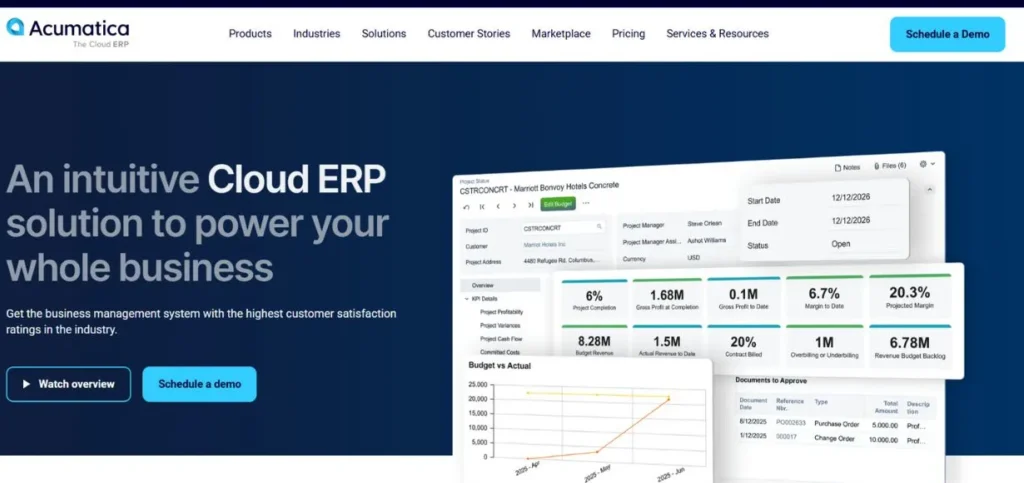
Acumatica is one of the ERP software for real estate options that has a distinct pricing system, consumption-based, whereby the prices are not determined by the number of users, but by the amount of resources consumed. This makes real estate firms very cost-effective where there are a large number of staff that require access to the system. It provides property management, financial tools and project management on a flexible cloud platform. Acumatica is doing especially well with the property managers and construction firms in need of modern, flexible ERP solutions.
Key Features:
- Consumption-based (not user-based) pricing.
- Project management module Construction.
- Financial KPIs in real-time.
- A cloud platform that is mobile-friendly.
- Powerful third-party integrations.
- Customizable workflows
Pros:
- Infinite users without any additional fee.
- Effective construction management instruments.
- Flexible and cloud-native
- Good partner ecosystem
Cons:
- At first sight, the interface can be complicated.
- Low out of box real estate capabilities.
- Needs to be customized to be fully useful.
- Support response can be slow
Pricing: Starts at ~$30,000–$80,000/year
Best For: Real estate companies with large teams needing broad access
Website: www.acumatica.com
4. Odoo
Odoo is an open-source ERP software that is popular in real estate and which is or has a modular design and is affordable. Odoo also provides an all round business solution, including CRM, accounting, project management, HR and property management modules, at a friendly price. It is particularly fit appropriately in startups and up-and-coming real estate companies that are not yet in need of the expensive nature of enterprise ERPs. It also has a large assortment of add-ons due to its active user base of developers.
Key Features:
- Open-source architecture and modular.
- CRM and lead management
- Tools of accounting and invoicing.
- Project and task management
- HR and payroll processing
- More than 80 country localizations.
Pros:
- Low and consumer-friendly prices.
- Big local community and add-on library.
- Easy to customize and scale
- User-friendly interface
Cons:
- Can require technical setup
- Enterprise functionality is more expensive.
- Community support varies
- They might require developers in case of complex integrations.
Pricing: Free (Community); ~$24.90/user/month (Enterprise)
Best For: Startups and SMBs in real estate
Website: www.odoo.com
5. Sage Intacct
Sage Intacct is a real-estating ERP cloud based software with eminent emphasis on financial management and consolidation of multiple entities. It especially fits well with REITs, real estate investment companies and property managers with complicated financial structures. Sage Intacct demonstrates good automation in billing, financial reporting as well as compliance workflow. Its strong acuity of accountancy features coupled with an easy to use interface make it exceptional in the selection of finance-intensive real estate businesses.
Key Features:
- Multi-entity financial consolidation.
- Computerized billing and invoicing.
- On the Fly Financial Reporting.
- Compliance with ASC 842 leases accounting.
- Cloud-based access anywhere
- In-depth accounting and audit software.
Pros:
- Financial management of the best of the best.
- Excellent in multi-entity companies.
- Strong compliance support
- Excellent customer support
Cons:
- Not as well suited to property operations.
- Advanced features are sold at higher prices.
- Minimal property specific modules.
- PM tools need to be integrated.
Pricing: Custom pricing (typically $15K–$50K/year)
Best For: Real estate investment firms and REITs
Website: www.sageintacct.com
6. Microsoft Dynamics 365
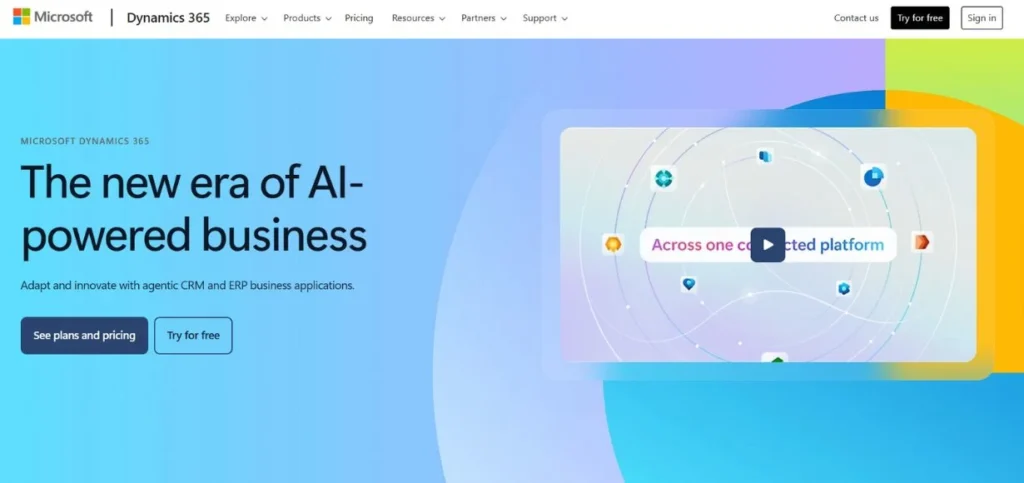
Microsoft Dynamics 365 is an ERP software for real estate that is enterprise-grade and based on the Microsoft cloud infrastructure. It is compatible with Microsoft 365, Teams, and Azure, which can be regarded as its best fit in real estate companies that are already on the Microsoft platform. Having modules specifically focused on finance, operations, sales, and customer service, Dynamics 365 can be configured to accommodate intricate real estate processes such as lease management, portfolio tracking and construction projects life cycle management.
Key Features:
- Smooth Microsoft 365 integration.
- Finance and operations management.
- artificial intelligence-based insights and analytics.
- Asset and lease management programs.
- Custom Power BI and Power Apps.
- Multi-currency and global compliance.
Pros:
- Premeditious Microsoft ecosystem integration.
- Powerful analytics using Power BI.
- Scalable for enterprise use
- Good community and vendor support.
Cons:
- High licensing costs
- Complicated configuration and personalization.
- May require IT team support
- Gold plating to the small business.
Pricing: Starts at ~$65–$180/user/month
Best For: Enterprise real estate businesses using Microsoft tools
Website: www.microsoft.com/dynamics365
7. Buildium
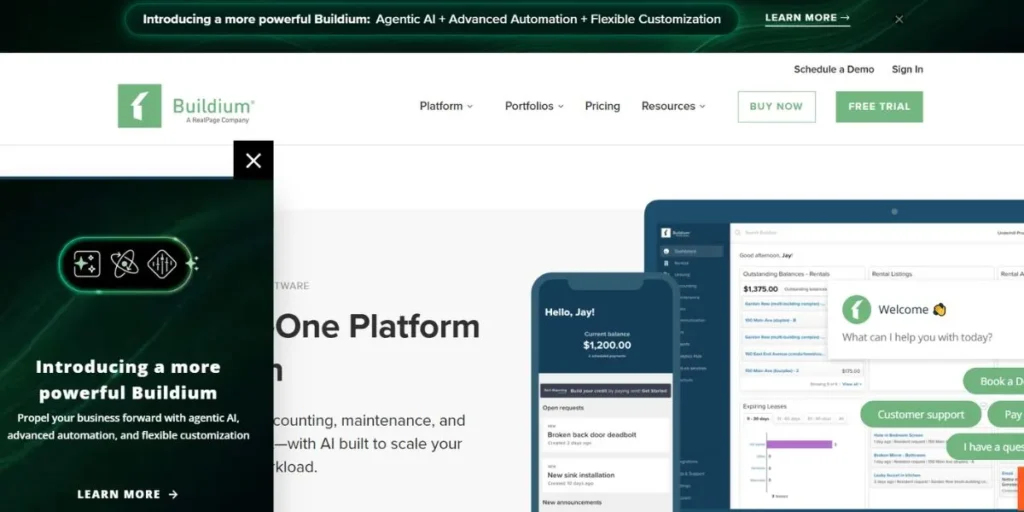
Buildium is a special purpose ERP software designed to be used by the property managers in the real estate property business and integrates both the property operations and finances in a single easy to use platform. It takes care of tenant background and lease tracking up to the maintenance requests and ownership reporting. Although it is not an ERP in the enterprise-wide sense of the word, Buildium can be considered as a full-fledged all-in-one solution to those residential property managers who seek to make the daily operations of the business smoother and increase the satisfaction levels of the tenants.
Key Features:
- Tenant and lease management
- Online rent collection software.
- Tracking of maintenance requests.
- Owner and tenant portals
- Financial reporting and accounting.
- Background checking and tenant screening.
Pros:
- Very easy to use
- Small managers can afford it.
- Superb communication tools with tenants.
- Good property-specific characteristics.
Cons:
- Poor performance under large portfolios.
- Is not a conventional full ERP system.
- inadequate customization.
- Advanced features cost more
Pricing: Starts at ~$52/month (Essential plan)
Best For: Residential property managers and landlords
Website: www.buildium.com
8. Yardi Voyager
Yardi Voyager is an ERP software for real estate specifically designed to support large property management companies, REITs and commercial property operators with large property portfolios. It provides an end to end platform encompassing property management, investment management, asset management, financial accounting and maintenance. Yardi voyager has decades of experience in the real estate industry, and therefore can be relied upon by organizations with hundreds or thousands of properties spread over various asset classes.
Key Features:
- Wholesale to retail property management.
- Investment and portfolio management.
- Portal of resident and commercial tenants.
- Work order management and maintenance.
- Complexed financial reporting and budgeting.
- Field team mobile access.
Pros:
- Along industry lines and highly competent.
- Good compliance and reporting.
- Large selection of modules offered.
- Superior with big portfolios.
Cons:
- Extremely high costs of implementation.
- Time consuming and complicated onboarding.
- Inappropriate with small businesses.
- Interface can feel dated
Pricing: Custom enterprise pricing (typically $100K+/year)
Best For: Large real estate operators and REITs
Website: www.yardi.com
9. DualEntry
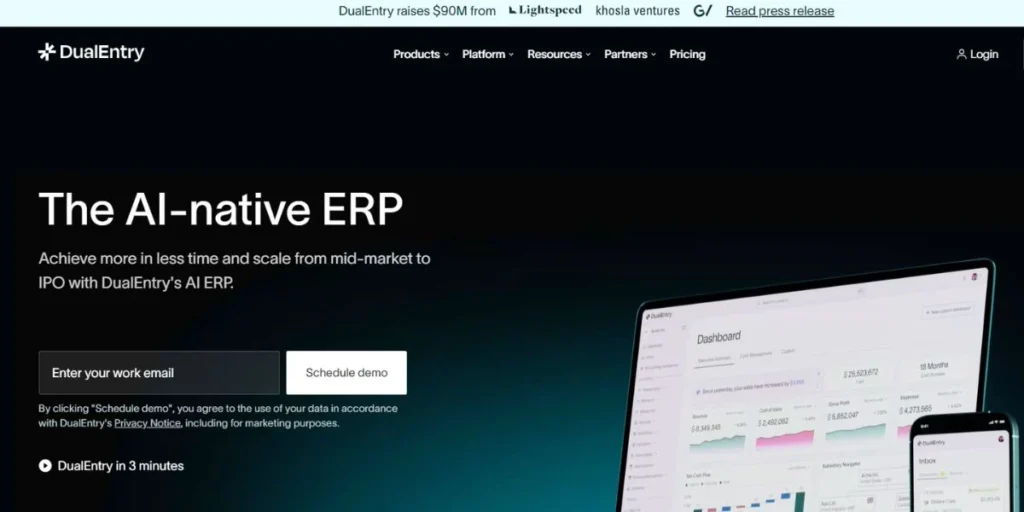
DualEntry The new AI-native real estate finance team ERP software designed to help companies automate their accounting processes and manage many organizations easily. It enables real estate companies to manage indefinite organizations, streamline the intercompany dealings, and assemble the financial information in real time on a solitary screen. DualEntry is especially handy with real estate firms having many properties, subsidiaries, or investment vehicles that require high-quality, automated financial controls that are not as complicated as their older ERPs.
Key Features:
- Accounting automation: AI-native.
- Real time multi-entity consolidation.
- Intercompany transactions that are automated.
- Cash flow dashboards in real-time.
- Integrations with financial tools.
- State of the art audit trail and controls.
Pros:
- Superior multi-entity management.
- The current AI-based automation.
- On-the-fly financial transparency.
- Easy to onboard and use
Cons:
- Newer platform of fewer integrations.
- Not as fit operational PM activities.
- Poor track record compared to legacy ERP.
- May requires more PM software.
Pricing: Custom pricing (contact vendor)
Best For: Multi-entity real estate investment groups
Website: www.dualentry.com
10. StrategicERP
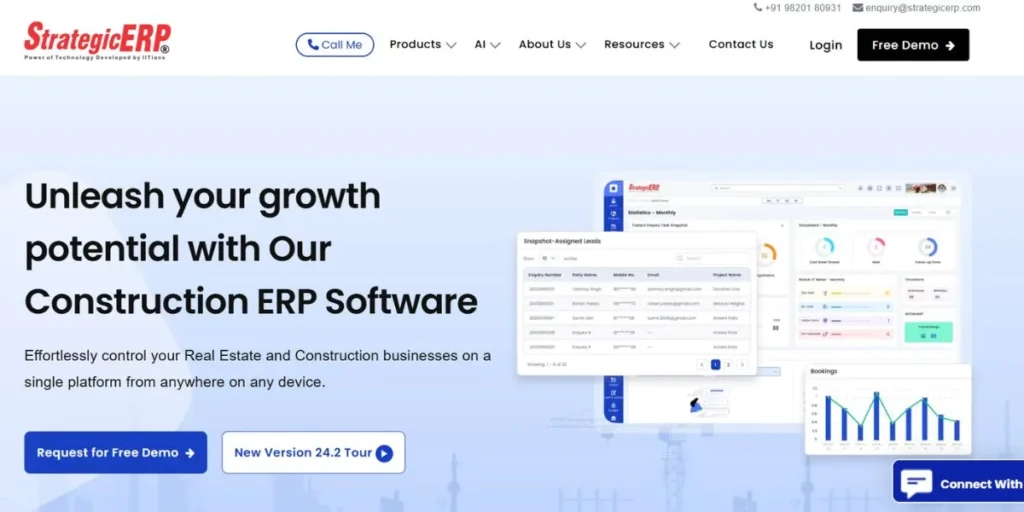
StrategicERP is an ERP software for real estate developers and provides a full end-to-end solution, which includes sales, CRM, construction management, procurement, finance, and statutory requirements such as GST and RERA. StrategicERP was developed, which is based on the real estate industry, and it has used AI, cloud technology, and business process automations to enable developers to efficiently and profitably run their projects. It particularly is popular among real estate developers in the emerging markets, who are in search of digital transformation.
Key Features:
- CRM and real estate developer sales.
- Tracking of construction and project.
- GST and RERA compliance solutions.
- Purchasing and supplier control.
- Portal and communications with customers.
- Artificial intelligence analytics and reporting.
Pros:
- Specifically designed to target the real estate developer.
- Good compliance and regulatory instruments.
- Cloud-ready platform and mobile.
- In-depth end to end coverage.
Cons:
- Mainly concentrated in South Asia markets.
- Lack of international options of integration.
- Smaller vendor ecosystem
- It may require time to implement it.
Pricing: Custom pricing (contact vendor)
Best For: Real estate developers and construction companies
Website: www.strategicerp.com
ERP Implementation Best Practices for Real Estate
- Set clear objectives: you need to know which issues to address and which modules are needed before choosing a platform.
- Engage the stakeholders: early, with finance, operations, and IT teams so as to achieve buy-in throughout the system.
- Introduce a gradual implementation to reduce disruption and give the teams time to adjust to the new system at a slow pace.
- Training: although the ERP is the best, users still cannot use it properly and consistently without training.
- Clean your data: clean it before migration to avoid importing old or duplicate records.
- Select an appropriate implementation partner: experience in implementing ERP specific to real estate to save unnecessary expenses.
Real Estate ERP Trends 2026
- AI and machine learning: are being incorporated into the ERP systems to automate forecasting, risk assessment, and lease management.
- Use of cloud first: All is gaining momentum, and on-premise ERP is quickly being overtaken by scalable SaaS platforms.
- Mobile accessibility to the ERP: field teams, property managers and executives are now demanding data on the move.
- Sustainability reporting modules: are becoming increasingly more popular as ESG compliance becomes the focus of regulation by real estate companies.
- Embedded BI and analytics: enable the use of real-time decision-making without additional reporting functionality or data export.
- No-code/low-code configuration: gives real estate companies the ability to customize ERP processes without intensive IT intervention.
Conclusion
One of the most influential technology choices your business will make is one that will help you select the correct ERP software for real estate. ERP solutions are available to small property managers all the way to large-scale REITs and developers at any budget and any need.
Regardless of whether you are more focused on financial management, property operations, or end-to-end developer workflows, the tools that have been listed in the present guide are the best in 2026. Before committing, take the time to evaluate the needs of your business, shortlist 2-3 platforms, and request demos. The ERP you want will not only operate your business, but it will also assist in expanding your business.
FAQs
What is real estate ERP software?
Real estate ERP software is a complete system that handles all business core functions; finance, property management, CRM, human resource and projects within a single system, which improves the efficiency with which real estate companies run.
What is the optimal ERP solution for small real estate companies?
Odoo and Buildium are great solutions for small real estate companies, as they are not too expensive, simple to learn, and can add or remove features.
What is the cost of the real estate ERP software?
Prices are all over the board – as cheap as $52/month, like Buildium, and as expensive as over 1 million/year, such as enterprise platforms like Yardi Voyager. Pricing is based on company size, modules, and deployment model.
Is it possible to manage property with the help of ERP software?
Yes. The majority of ERP software for real estate includes property management modules that handle lease tracking, maintenance requests, tenant portals, rent collection, and compliance reports.
What is the time required to deploy an ERP system in real estate?
Small firms take between 3-5 months, with large firms taking between 12-24 months as an implementation plan, depending on the complexity, data migration requirements, and the modules to be implemented.