


Do you want to move to Germany or do you just want to plan your finances before the big move? The first and the most significant step includes understanding the cost of living in Germany in 2026. Germany is one of the most robust economies in Europe with a high level of living, healthcare, good education, and excellent transportation.
Costs can differ greatly depending on the cities, and the lifestyle of a student who needs to go to Berlin, a professional who has to move to Munich, or a family that has to go to Hamburg. It takes you through all the key costs: rent, food, transport, and so on and thus you can plan your budget, make informed decisions, and know exactly what to expect when you get there.
Average Cost of Living in Germany 2026

In 2026, the cost of living in Germany are estimated to be between €1200 and €2000 a month, which includes rent, food, transportation, health care, and entertainment of a single individual. Big cities such as Munich and Frankfurt are towards the upper end whereas little and eastern cities such as Leipzig and Erfurt are much cheaper.
The average budget a couple spends is €2,500 to €3,800 a month. The effective social infrastructure in Germany, such as subsidized public transport, mandatory health insurance, and free public higher education, contributes to the fact that residents of the country find it easier to balance costs than in most other output-western European countries.
Also Read: Cost of Living in Australia
Which Region Has the Highest Cost of Living in Germany?
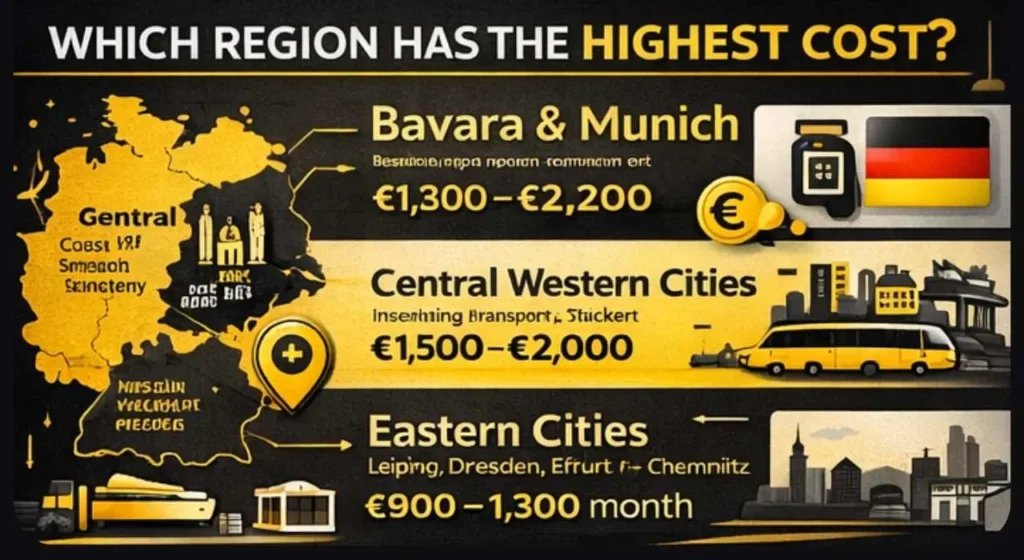
Bavaria (and Munich in particular) has the most expensive cost of living in Germany. Munich is always among the priciest cities in the entire Europe and rent in the city centre is regularly above €1,800 to €2,200 per month on a one-bedroom apartment.
Frankfurt, Hamburg and Stuttgart are also among the high ones with financial and corporate significance. States in Eastern Germany like Saxony and Thuringia are the cheapest with the cost of living being 30 to 40% less than in western urban areas and still having a good infrastructural base and quality of life.
Cost of Living for Students in Germany in 2026
Germany is a country that is quite accommodative to students and a great deal of its universities charge no or very minimal tuition. The following will give the breakdown of the normal monthly student expenses in 2026:
- Rent (student dorm or shared flat): €350 – €700/month
- Groceries and food: €150 – €250/month
- Health insurance (mandatory): €80 – €120/month
- Semester transport ticket: €100 – €200/month (often bundled in semester fees)
- Phone and internet: €20 – €40/month
- Books and stationery: €20 – €50/month
- Entertainment and social activities: €50 – €100/month
- Utilities (if not included in rent): €60 – €100/month
- University canteen (Mensa) meals: €3 – €5 per meal
- Total estimated monthly budget: €900 – €1,600/month
German student life is quite affordable, particularly when compared to the UK or Australia, and even part-time employment (up to 120 full days a year) helps to manage the costs.
Cost of Living for Couples in 2026
In Germany, it would be more cost-effective to live as a couple because there are many shared fixed costs. The following is an approximate monthly budget of couples in 2026:
- Rent (2-bedroom apartment, city center): €1,400 – €2,500/month
- Groceries and household supplies: €400 – €650/month
- Health insurance (both partners): €350 – €600/month
- Public transport or car expenses: €150 – €450/month
- Utilities (electricity, water, heating): €150 – €280/month
- Dining out and entertainment: €200 – €450/month
- Phone and internet: €50 – €80/month
- Clothing and personal care: €100 – €200/month
- Travel and leisure (monthly average): €100 – €250/month
- Total estimated monthly budget: €2,900 – €5,460/month
Cost of Living in Germany in Indian Rupees
To the Indian nationals intending to study or work in Germany, conversion of expenses to the Indian Rupees can assist in realistic financial planning. The following figures are reflective of a proximal exchange rate of 1 EUR = INR 90 in the year 2026:
- Rent (1-bedroom apartment): €700 – €1,500 = INR 63,000 – INR 1,35,000/month
- Monthly groceries: €200 – €350 = INR 18,000 – INR 31,500/month
- Public transport pass: €80 – €120 = INR 7,200 – INR 10,800/month
- Health insurance: €80 – €120 = INR 7,200 – INR 10,800/month
- Dining out (per meal): €10 – €20 = INR 900 – INR 1,800
- Phone and internet: €30 – €50 = INR 2,700 – INR 4,500/month
- Total monthly cost (single person): Approximately INR 1,10,000 – INR 2,20,000/month
In Indian Rupees, cost of living in Germany is high, yet the local wages and student part-time earnings render it affordable to the earners in Euros.
Cost Comparison: Germany vs Other Countries
| Expense Category | Germany | United Kingdom | Netherlands | Switzerland |
| 1-Bedroom Rent (City Center) | €900 – €1,500 | £1,300 – £2,200 | €1,100 – €1,900 | CHF 1,900 – 3,000 |
| Monthly Groceries | €200 – €350 | £260 – £420 | €230 – €400 | CHF 450 – 650 |
| Monthly Transport Pass | €80 – €120 | £100 – £200 | €90 – €140 | CHF 70 – 130 |
| Dining Out (one meal) | €12 – €22 | £14 – £28 | €13 – €24 | CHF 22 – 45 |
| Health Insurance | €80 – €120 (public) | Included (NHS) | €130 – €170 | CHF 320 – 480 |
| Average Monthly Total | €1,200 – €2,000 | £1,900 – £3,200 | €1,500 – €2,500 | CHF 3,200 – 5,500 |
What Is the Average Rent in Germany?
The cost of living in Germany is mostly due to rent as it is the largest expenditure among most residents. As of 2026, a one-bedroom apartment in one of the city centers would cost between €900 in a mid-sized city and €2,200+ in Munich. The rent in the outskirts of cities is normally less by 20 to 35%.
One of the most popular and functional options is shared flats, also referred to as Wohngemeinschaften (WGs) – a single furnished room in a shared flat costs between €400 and €800 a month (including utility costs are quite common). The average price of a one-bedroom in the center of Berlin stands at €1,200 to €1,600, whereas Hamburg is a bit pricier. It is highly recommendable to begin searching your apartment three to four months ahead due to the high demand in the large cities.
How Much Does Dining Out Cost in Germany?
Germany boasts of very diverse cuisine with cheap street food down to fine restaurants. The following is what to expect to spend in 2026:
- Kebab or fast food meal: €6 – €10
- Lunch at a mid-range restaurant: €12 – €18
- Three-course dinner at a restaurant: €25 – €45 per person
- Beer at a local pub or bar: €3.50 – €6
- Cappuccino or latte at a cafe: €3 – €5
- Pizza at a sit-down restaurant: €10 – €18
- Daily lunch special (Tagesmenü): €8 – €14
- University canteen (Mensa) meal: €3 – €5
- Food delivery order (per order): €12 – €28
- Weekly groceries for home cooking: €45 – €85
Germany vs India: Cost Comparison
| Expense | Germany (EUR) | India (INR) | Germany in INR |
| Monthly Rent (1BHK) | €900 – €1,500 | INR 10,000 – 30,000 | INR 81,000 – 1,35,000 |
| Monthly Groceries | €250 – €350 | INR 5,000 – 9,000 | INR 22,500 – 31,500 |
| Dining Out (per meal) | €12 – €20 | INR 150 – 500 | INR 1,080 – 1,800 |
| Monthly Transport | €80 – €120 | INR 500 – 2,500 | INR 7,200 – 10,800 |
| Health Insurance | €80 – €120 | INR 500 – 3,000 | INR 7,200 – 10,800 |
| Average Monthly Salary | €2,500 – €4,500 | INR 25,000 – 80,000 | INR 2,25,000 – 4,05,000 |
Germany vs USA / Canada
| Expense | Germany (EUR) | USA (USD) | Canada (CAD) |
| Monthly Rent (1BHK, City) | €900 – €1,500 | $1,600 – $3,200 | CAD 1,800 – 3,500 |
| Health Insurance | €80 – €120 (public) | $300 – $800 (private) | Mostly covered (public) |
| Monthly Groceries | €250 – €350 | $300 – $550 | CAD 350 – 580 |
| Public Transport | €80 – €120 | $50 – $160 (limited) | CAD 100 – 170 |
| Dining Out (per meal) | €12 – €22 | $15 – $35 | CAD 16 – 38 |
| Average Monthly Total | €1,200 – €2,000 | $2,600 – $4,800 | CAD 2,700 – 4,500 |
Which City Is Cheaper?
In the comparison of the cost of living in Germany among the cities, eastern Germany always wins. Leipzig is said to be the cheapest major city in the country, one-bedroom apartments cost only an average of €600-950 per month – a mere fraction of Munich.
The costs are also very cheap in Dresden, Erfurt, Chemnitz and Magdeburg, yet the cities have strong urban facilities and transport connections. Dortmund, Duisburg and Bremen, are at the more affordable end of the western cities. Berlin provides a compromise – cheaper than Munich or Frankfurt, but urbanized and full of possibilities. In 2026, the best choice would be Leipzig and Dresden to movers who are cost-conscious.
Salary and Living Standards
Germany provides good wages compared to its living standard thereby being appealing to the qualified workers and graduates. Key figures for 2026:
- National minimum wage: approximately €12.82 per hour
- Average gross monthly salary: €3,500 – €5,500 (varies by sector and experience)
- Average net monthly salary (after tax and social contributions): €2,200 – €3,800
- Income tax rate: 14% to 45% (progressive system)
- Social security contributions: approximately 20% of gross salary, split with employer
- IT and engineering professionals typically earn €4,500 – €7,000 gross per month
- Healthcare workers earn €3,000 – €5,500 gross per month
- Public university education is largely free, even for international students
- Child benefit (Kindergeld): approximately €255 per month per child
- Quality of Life Index: Germany consistently ranks in the global top 15
Tips to Reduce Living Costs in Germany
- Shop in discount supermarkets: Aldi, Lidl, Penny and Netto are stores that sell quality groceries at a lower cost (30-40%) compared to upscale stores such as Rewe or Edeka.
- Select a shared apartment (WG): one of the quickest methods of cutting the largest monthly payment consists of sharing with flatmates rent and utility fees.
- Travel by bus and bicycles: a car is a luxury in Germany; it is costly to insure, fuel and parking fees are quickly spent in metropolises.
- Shopping second-hand furniture and electronics: the online auctions platform such as eBay Kleinanzeigen offers second-hand goods that are barely used and at a very low price, which is perfect when newcomers have to furnish an apartment.
- Take advantage of student and social discounts: museums and cinemas as well as gyms and transit systems provide discounts on students or job seekers and low-income residents.
- Cook yourself and prepare your meal once a week: the concept of batch cooking will save you time and money and keep your monthly food budget conveniently low.
Conclusion
It is a fact that in 2026 the cost of living in Germany will be more expensive than in most developing countries, yet it is accompanied with unparalleled quality of life, robust social security and one of the most stable economies in Europe. Germany is offering real value in money in day-to-day living with tuition free higher education institutions and free public healthcare at its very finest.
You can afford to live in the bustling Munich or the cost-effective quiet of Leipzig and proper budget planning and prudent lifestyle decision-making will be what makes your time in Germany comfortable and financially stable. Given due preparation and sensitivity, the cost of living in Germany is highly affordable to the students, the couples, families, and even the professionals.
Frequently Asked Questions (FAQs)
How much would I spend every month in order to live in Germany in 2026?
On the one hand, one individual can survive on €900-1200 in the month in minor eastern cities but the amount of €1500 or more is suggested to be comfortable in the large cities such as Berlin or Frankfurt.
Is living in Germany cheaper than in the UK?
Yes, generally. Germany is cheaper in terms of living expenses- especially in rent, health care and transport as compared to London and other large cities in the UK.
What is the cost of public health insurance in Germany?
Public health insurance is estimated to cost between €80 and €120 a month to the students. To the employee, it is approximately 14 -16% of gross salary which is divided between the employee and the employer.
Is it possible that a student could have a cost of living in Germany of €1000 a month?
Yes, and in low cost cities such as in Leipzig, Erfurt or other small university towns. A room or communal apartment, a semester subway ticket and homemade meals is quite feasible at 1000 euros a month.
What will be the lowest priced big city to live in in Germany in 2026?
Leipzig is generally considered in 2026, the cheapest of all major cities in Germany, and after that, Chemnitz, Magdeburg, and Erfurt would give a good quality of life at a much lower price than Munich or Hamburg.