

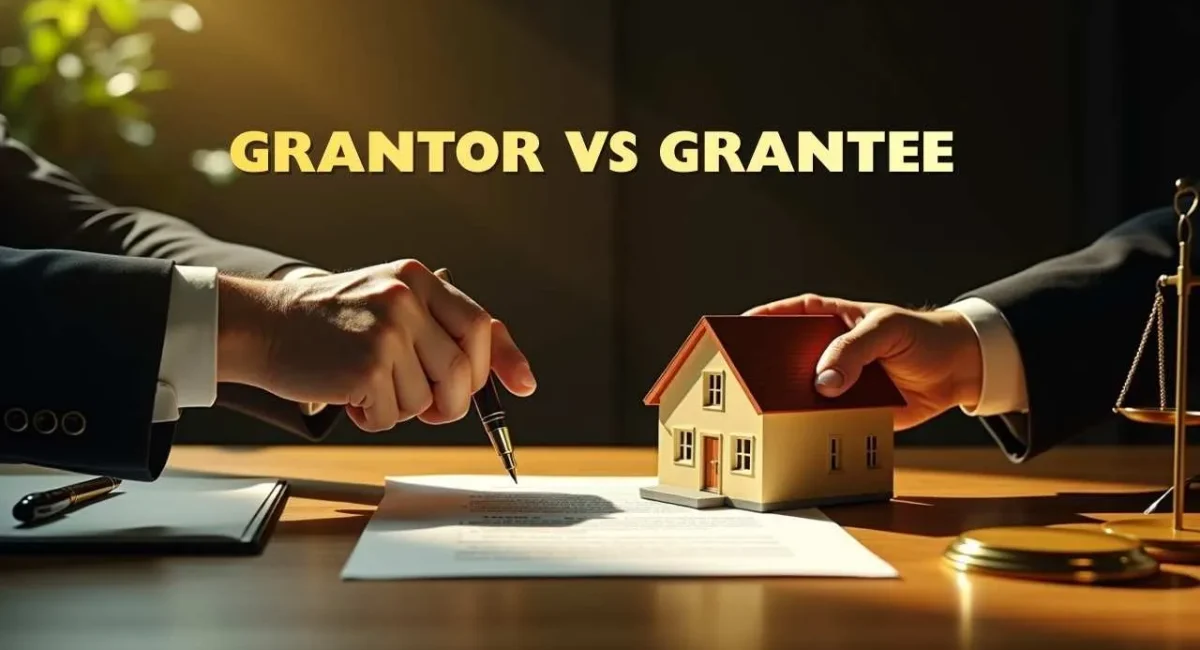
You will encounter the concepts of grantor vs grantee almost in every legal document, should you be selling or buying a home. These two functions are the heart of any real estate transaction, be it deeds and mortgages or liens and easements.
The U.S had sold 3.91 million existing homes per year in January 2026. The median price of a home was $396,800. According to the National Association of Realtors, home sales will increase 14 per cent by 2026, hence very many millions more people will shortly be signing either 1, as a grantor, or 2, as a grantee, papers.
Understanding grantor vs grantee would prevent expensive errors, signingthe wrong documents, and losing rights. The roles make the entire exercise simple and less challenging, regardless of whether you are purchasing your first house or investing in your existing property.
What Is a Grantor?
The individual or entity that owns the property and transfers the property to someone else through a document known as a deed is known as a grantor. In the majority of cases, the seller is the grantor. At the end of 2025, the median cost of new houses in the U.S. was $498,000, and in all purchases, the ownership of the house was that of the grantor. Transfer of the property should be possible only when it is legally owned by the grantor.
Another Name for Grantor
The first party in a real estate contract is also referred to as the grantor. A lessor is a grantor in a lease. The grantor would be the borrower who offers the property as a guarantee in a mortgage. The term transferor might also have official uses.
Are Grantor and Owner the Same?
Yes, the existing owner of the property is the grantor. The grantor must be a full and legal owner of a deed prior to its signing by him or her. By 2026, the homes that will not be sold out at that time will be about 1.22 million, and this means that a good number of owners will become grantors when they sell.
It does not necessarily have to be a person who lives there, who could also be a grantor, a bank, a city, or a trust. The primary principle is that one has to be the owner of the property in order to transfer it.
Can Grantor and Grantee Be the Same Person?
In other instances, one may be a grantor vs grantee simultaneously. This occurs when property is transferred to a self-managed trust, and this is the usual affair of estate planning. By 2025, over 30 percent of property transactions in the U.S. were subject to a trust, etc.
When the owner of the title is of a different type such as a person to a trustee, the individual may appear on both sides of the grantor vs grantee positions.
What Is a Grantee?
The individual or group receiving the grant is referred to as a grantee. Under normal sale of a home, the buyer is the grantee. Once the signature to the deed is affixed and registered, the grantee gets the title. New single-family homes sales are projected at 745,000 units per year in the U.S. in December 2025, after which all purchasers were the grantees. It is also important to know the role that the grantee plays in the grantor vs grantee relationship.
Does Grantee Mean Owner?
Once a deal is completed, the grantee acquires the status of the real owner. Their name appears in the deed and in the record of the public property. However, the property is not owned by the grantee at the time of the deal being underway.
Their ownership only follows registration of the deed. The homes are worth stakes in 2026 when the average home price is projected to be at $396,800. To sell the title of a valuable piece of property is to be the legal grantee.
Example of a Grantee
To take an example, a couple purchases a California house at a price of 750,000. The seller signs a warranty deed, and hence the couple starts to be the grantees. The deed is registered in the county and they become the casual proprietors. Another example: a bank is made to take over a property when a loan is foreclosed and resells it.
This was originally vested in the bank as the grantee (upon the foreclosure having acquired the deed thereto) and subsequently (on its sale of the house) transferred as the grantor. This is typical in switching roles in U.S. real-estate deals.
Grantor vs Grantee (Side-by-Side Comparison)

| Feature | Grantor | Grantee |
| Role | Gives/transfers property | Receives property |
| Also Called | Seller, lessor, transferor, first party | Buyer, lessee, transferee, second party |
| Signs the Deed | Yes | Usually yes, to accept |
| Holds Title Before Deal | Yes | No |
| Holds Title After Deal | No | Yes |
| Legal Responsibility | Clear title, full disclosure | Accept terms, fulfill obligations |
| In a Mortgage | Borrower pledging property | Lender receiving security interest |
| In a Lease | Landlord | Tenant |
| In a Judgment | Judgment creditor | Judgment debtor |
| Deed Type Used | Decides type of deed | Receives protections based on deed type |
Grantor vs Grantee in Real Estate Documents
Grantor vs Grantee Mortgage
The roles may be backwards in a mortgage. Its grantor is the borrower (homebuyer). They provide security to the lender as far as the house is concerned. The grantee is the lender who retains a lien over the house before the wing loan is disbursed.
As of early 2026, the housing affordability score in the U.S has improved since March 2022. The reason is that wages have increased and mortgage rates have slightly decreased. Nonetheless, when the deal closes, it is still best to know who the grantor is and who the grantee is in a mortgage to avoid confusion.
Grantor vs Grantee Deed of Trust
The deed of trust involves three individuals: the borrower ( grantee ), the lender ( beneficiary ), and a refereed trustee. The lender provides the title of the property to the trustee, who holds it on behalf of the lender until repayment of the loan.
This arrangement applies in approximately 30 states in the U.S. Under the grantor -grantee sections of a deed of trust, the title is parted with temporarily by the grantor to obtain the loan, and the loan is retained by the lender, who is the ultimate beneficiary of the loan.
Grantor vs Grantee Lien
In case a person secures a lien on a house, such as unpayable taxes or work, the grantee of such a claim is the person who secures a lien. The grantor is the owner of the money. Approximately one out of 30 homeowners in the United States became non-payers in 2025.
In this type of lien, there is no surrendering of rights by choice on the part of the grantor; the lien is a legal possession preventing what they may do with the house until the debt is paid.
Grantor vs Grantee Judgment
In a court proceeding where the grantor and the grantee win and lose respectively what is the case, the person the court records against is the grantor and the other the grantee. This can feel odd. There is an example that when an individual wins a lawsuit and judgment is done against a property, the property of the debtor is subject.
In such situations, publicly, one can see both of them, and the title is worth checking. Some 90 percent of real estate attorneys recommend an extensive title search prior to purchase.
Grantor vs Grantee Divorce
A typical case of divorce where the grantor and the grantee roles are significant occurs. In the separation of the couple, the interspousal transfer deed or quitclaim deed can be used, whereby one spouse (the grantor) gives his or her share of the property to the other spouse (the grantee).
Approximately 45 percent of the U.S. divorces in 2025 will be shared real estate. The conjugating husband forfeits the right of property, whilst the recipient husband becomes the absolute grantee.
Grantor vs Grantee Easement
An easement allows a person to utilize the land of another person for a given purpose, such as a driveway or utility line. The one who gives the right is the grantor, and the recipient is the grantee. All the right is transferred, not ownership.
The number of easement agreements recorded every year in California is in the hundreds of thousands. The importance of the Grantor-Grantee easement relationship is that it would affect the value of the property and consequent negotiations of sale in the future.
Types of Deeds Explained
Quitclaim Deed
The quitclaim deed conveys ownership of the interest that the grantor holds in the property, whether there is a promise or not. The grantee receives the full title in case the grantor is a complete owner. The grantee encounters precisely that, in the event that the ownership of the grantor is partial or unclear. Quitclaim deeds are prevalent in family transfers, divorces, and trusts.
They are quick and easy but provide minimal security to the grantee. In 2025, an estimated 1520 percent of all transfers in residential property in the U.S. included quitclaim deeds since they are simple to carry out in transactions not involving arm’s length.
Warranty Deed
When there is a warranty deed, which is in general terms, it is the most protective in the relationship of the grantor and the grantee. This is ensured by the grantor, who will ensure the title is free of any silent lien or encumbrance over the title and that he will defend the grantee to a future claim of a title, one that might be prior to his ownership.
Over 70 per cent. Typical domestic sales involved the utilization of a general warranty deed in 2026 in the U.S. It became the default option in most cases of stranger-to-stranger home sales.
Important Legal Terms Explained
Habendum Clause
Habendum is a section of a deed that determines what rights of ownership are being conveyed out of the grantor on to the grantee. It normally begins with the phrase to have and to hold. The clause indicates the permanency, permanence-temporality or conditionality of the transfer.
The habendum clause is particularly significant in commercial real estate, which experienced a transaction amounting to more than 700 billion in 2025. A habendum clause is a clause that is written poorly, which may cause challenges in determining what the grantee actually acquired.
Escheat
Escheat is a legal procedure that allows a property to go to the state in case the owner, the grantor, has died without a will or other heirs, and there is no lawful grantee to obtain the title. The United States escheat laws are provided under each state.
States together restored property worth more than 3 billion dollars in unclaimed property valued property, including real estate assets, by 2025 in an escheat action. The knowledge of escheat plays a vital role in the grantor-grantee scheme since it demonstrates the situation in the absence of a legitimate title holder.
Grantor vs Grantee in California
In California, there are particular types of deeds and title transfer regulations, with the grantor-grantee dynamic that is exceptionally significant in the state. The grant deed and the quitclaim deed are the most widespread actions in California. California grant deed. A California grant deed declares that the grantor has not sold the property to another party in the past and that there are no unrecorded mortgages.
California reported a higher number of residential property transactions in 2025 at more than 400 000. All the deeds also need to be notarized and registered in the office of the county recorder in order to be valid, as stipulated by the state. Major tax implications can be the difference between knowing who is the grantor and who is the grantee in California divorces and in trust transfers.
Also Read: Home Loan vs Mortgage
Conclusion
It is imperative that one comprehends the distinction between grantor vs grantee when relating to real estate purchasing and selling, refinancing, or a legal battle. As of January 2026, nearly 3.91 million homes were sold in the United States, and the number of sales is projected to go up by 14 percent during the remainder of the year. A large portion of the population will be in one of such positions. The rights are bestowed by the grantor and are passed on by the grantee.
All grantor vs grantee positions contain certain legal obligations and protections. Know your role, and you will be able to sign the correct documents, guard your title, and get the transaction finished with all the confidence.
Also Read: Direct vs Regular Mutual Fund
FAQs
1. What is the main difference between a grantor and a grantee?
The rights to property are given by the grantor, and are received by the grantee.
2. Who is the grantor in a mortgage?
In a mortgage, the grantor is the borrower since he/she promises to secure the lender with his property as it is the security granted to the lender.
3. Can the same person be both grantor and grantee?
Particularly in transfers of trust or restructuring ownership. In some cases, one individual is allowed by law to be both the transferring and the receiving party.
4. Which deed offers the most protection to a grantee?
A general warranty deed will provide the greatest protection in the sense that it will grant a clear title and guarantees legal defense against all claims even those prior to the granting of the deed to the owner.
5. How do I find grantor and grantee information for a property?
Registry of grantors and grantees You can find the records of grantors and grantees at your county recorder’s office or at the property portals on the internet that exhibit theFlow oftitle to each of the recorded deed.