

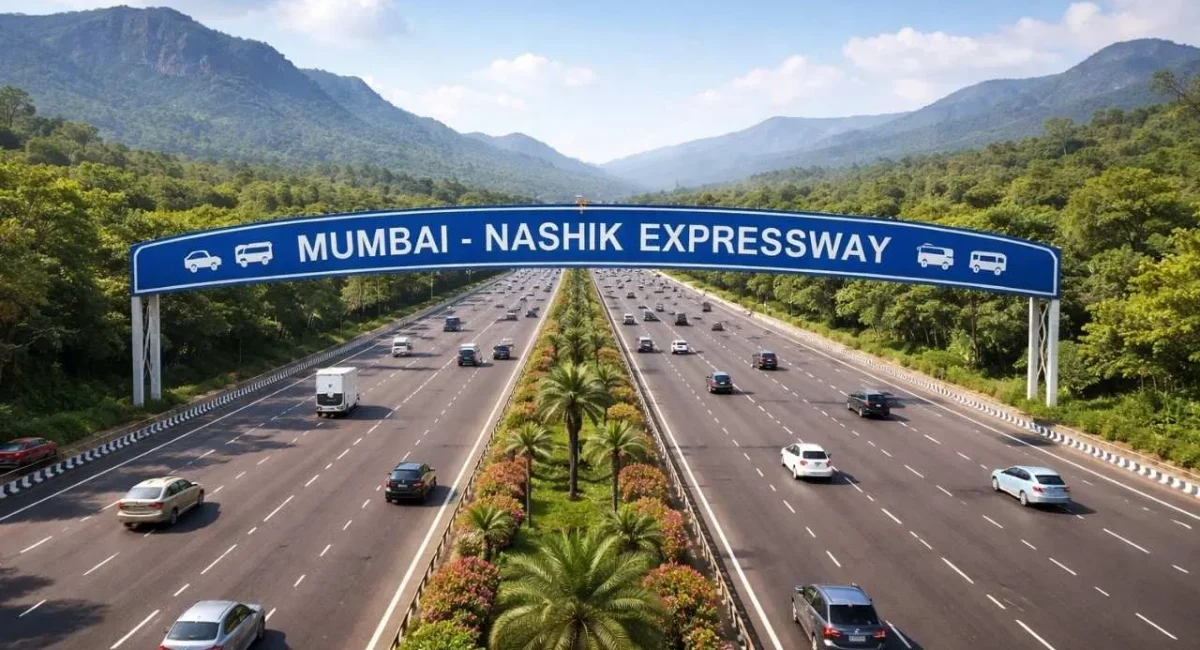
Ever wondered how a single highway can change the way a state moves? The Mumbai-Nashik Expressway Route does just that! Stretching over 150 km, it’s not just a road—it’s the lifeline of Maharashtra’s trade, tourism, and daily travel. Whether you’re heading to Nashik’s famous vineyards for a weekend escape or transporting goods from Mumbai’s busy ports, this highway makes the journey smooth and fast, cutting travel time to just about 3.5 hours.
Thanks to major upgrades, including 12-lane expansions and smart pothole repairs using Leo Polymer Technology, the expressway now handles heavy traffic and monsoon rains like a champ. The road has also sparked economic growth, turning towns along the route into thriving warehouse and industrial hubs.
With the NH-160A feeder stretch getting a ₹3,320 crore upgrade and new residential projects popping up in Shahapur and Igatpuri, the Mumbai-Nashik Expressway is shaping the way people live, work, and travel—while offering some of the most scenic drives in Maharashtra through the Sahyadri mountains.
What Is the Mumbai Nashik Expressway?
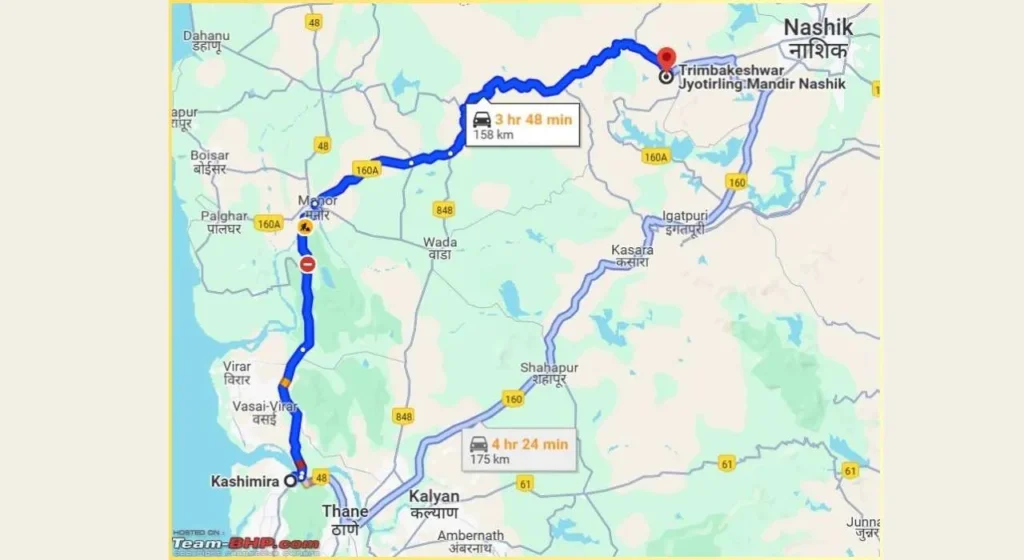
The Mumbai-Nashik expressway, which is also known as NH160, is a high-speed road stretch of 150 km that acts as a link between India’s financial capital, Mumbai, and the popular “Wine City,” Nashik. The expressway is made up of four to six lanes of undivided road, capable of handling the enormous traffic of thousands of vehicles on a daily basis. One of the most important sections of the Mumbai Nashik Expressway is the 99 km stretch of the highway between Vadape and Gonde, which was the first of its kind in India, being the biggest BOT (Build Operate Transfer) venture in the country at the time of its development.
In order to ensure a smooth flow of vehicles on the Mumbai-Nashik Expressway, there are six significant flyovers, along with several bypasses, constructed on the highway. In the latter half of 2025, another new project was approved to develop a new 48 km stretch of Nashik Ring Road, which will cost the exchequer a whopping amount of ₹5,805 crore to ease the burden on the city’s roads. In addition to that, the MSRDC is also planning to expand the 23 km stretch of the highway to 12 lanes to cope with the increase in traffic in the future.
- Total Length: 150 kilometers of high-speed connectivity.
- Route: Connects Mumbai via Vadape to Nashik via Gonde seamlessly.
- Configuration: Features a four to six-lane divided carriageway.
- Key Upgrades: The Vadape-Gonde stretch was a pioneer as it was India’s largest BOT (Build-Operate-Transfer) venture.
- Significance: It connects important logistical centers such as Padgha and Shahapur with the city.
- New Ring Road: The Nashik Ring Road project, which covers a stretch of 48 km, was approved at a cost of ₹5,805 crore in late 2025.
- Modern Construction: High-grade materials have been employed for the construction, which is suitable for the heavy axle load of thousands of industrial trucks.
Also Read:
Importance for Commuters, Logistics & Real Estate
The Mumbai Nashik Expressway is a catalyst for development across multiple sectors, making a massive impact on how people live and work, as follows:
- Industrial Growth: The expressway has given rise to new industries, including pipe manufacturing and quarrying, along its route. Moreover, these industries also stand to gain from the expressway, providing easy connectivity to the port facilities at Mumbai for export purposes.
- Warehousing Hubs: Padgha and Shahapur have become the state’s most important warehousing hubs. Moreover, major e-commerce companies are also establishing huge warehousing facilities at these locations, which is strategic for the MMR region.
- Job Creation: With new industries coming up along the expressway, employment opportunities have increased for the local population. Moreover, several service-based industries, including hotels and repair facilities, have also come up along the expressway.
- Property Value: Areas such as Majiwada and Kalyan have seen annual growth rates of over 5% over the past 5 years. Nevertheless, housing is still affordable, making these places suitable for first-time homebuyers.
- Tourism Growth: Easy connectivity to Trimbakeshwar Temple and hill stations near Igatpuri has driven growth in tourism activities. Moreover, “wine tourism” in Nashik is also a result of easy connectivity with these locations.
- Connectivity to Samruddhi: The expressway now acts as a feeder road for the Samruddhi Mahamarg. Moreover, this creates a super-corridor effect, connecting Mumbai with even the remotest corners of Vidarbha.
Mumbai-Nashik Expressway Route Map
The Mumbai Nashik Expressway is an important route that passes through the Sahyadri mountain range, providing utility and beauty to the region.
Route Overview
The Mumbai-Nashik Expressway route starts at Vadpe in the Thane region, passing through Gonde in Nashik. This route serves as the primary connector between the Mumbai Metropolitan Region, also known as MMR, and North Maharashtra.
- Major Interchanges: The important places along the Expressway route include the interchange at Kalyan, as well as the interchange at Padgha. These places help in the diversion of local traffic away from the main route to maintain the high speed of vehicles on the Expressway route.
- Key Toll Plazas: The important tolls on the Expressway route include the tolls at Arjhunali in the Thane region, as well as the toll at Ghoti, which is close to Nashik. Additionally, the toll at Ghoti serves as the entrance to the popular hill station of Igatpuri.
- Important Junctions: The Mumbai Nashik Expressway route links up with the upcoming Samruddhi Mahamarg, as well as the Nashik Ring Road. Additionally, these places are being developed with grade separators to ensure that there is no stoppage of vehicles on the Expressway route.
- Scenic Waypoints: The Expressway route passes through the stunning Kasara Ghat, which is also referred to as Thal Ghat. Additionally, the Mumbai-Nashik Expressway route provides a scenic view of the Western Ghats during the monsoon season.
Mumbai-Nashik Expressway Completion Date & Project Timeline
The Mumbai Nashik Expressway route is a prime example of the development of world-class infrastructure in Maharashtra. In the last two decades, the Mumbai-Nashik Expressway route has evolved from a normal highway to a modern multi-lane highway, which serves as the economic engine of Maharashtra.
2005: The Starting Line
The project took off with Mumbai-Nashik Expressway Private Ltd. (MNEL) winning the contract to develop the Vadape-Gonde stretch of the expressway as a mega infrastructure project. This phase primarily involved transforming the existing road into an expressway that could accommodate the fast pace of development in the Nashik-Bhiwandi region. In addition, it provided the basis for the development of the BOT model that was to become a template for all other highway projects in the state.
2009-2011: Opening the Gates
The project took off in 2009, with all phases of the project completed in January 2011, albeit with technical extensions to complete certain complex stretches. These technical challenges included traversing the difficult terrain of the Western Ghats, in addition to constructing bridges over seasonal rivers. More importantly, it was in this phase that commuters began to see a reduction in travel time, thus realizing the practical utility of the project to their daily lives.
2019: Expansion Phase
A private company took up the task of expanding the stretch from Majiwada to Vadpe into an eight-lane expressway to accommodate the enormous growth in traffic from the Mumbai side, which had become a problem with the existing four lanes, now a major bottleneck for traffic from the Mumbai Metropolitan Region (MMR). This phase, therefore, saw new concepts in traffic management introduced in the planning phase to ensure the smooth flow of vehicles at the busy Bhiwandi-Kalyan stretch.
2021: MSRDC Takes Charge
The Maharashtra State Road Development Corporation took over the widening project to fast-track the work and ensure that it meets the standards required for high-speed travel. The centralization of the work by the government ensured that there was an increase in the work done on the ground. Additionally, the MSRDC ensured that quality control measures were put in place to ensure that the infrastructure could withstand the rains that come during the monsoon season in the Konkan region.
2024-2025: Massive Upgrades
The construction of the Mumbai Nashik Expressway will continue with the upgrading of some of the infrastructure to a 12-lane highway. The upgrades will ensure that the highway has the Leo Polymer Technology, which will provide the road with the necessary longevity and prevent wear and tear. Additionally, the incorporation of advanced technology in the toll systems and surveillance will enhance the security of the highway and make it convenient for daily commuters.
2026: Future Completion
The total widening project will be completed by March 2026. As of February 2026, the Saket Creek bridge has already been tested with heavy vehicles and will be opened within days. The Kasheli bridge will also be completed by the end of the month. Once these final pieces are put in place, the highway will function as one and will reduce the commute time from Mumbai to Samruddhi Mahamarg.
Is the Mumbai Nashik Expressway Open?
Yes, the Mumbai Nashik expressway is open for use. However, note that:
- Active Construction: Even though the road is open for use, there are active constructions along the stretch between Thane and Vadpe, specifically for the 8-lane widening of the road.
- Lane Restrictions: There are also possible lane diversions along the stretch between Vadape because of the 12-lane expansion project that is currently going on along the highway. Besides that, there are extra marshals deployed along the highway to ensure the smooth flow of traffic in these zones.
- Weather Conditions: During the heavy monsoons that sometimes hit the state of Maharashtra, there are possible slow-moving traffic jams along the Kasara Ghat stretch of the highway. However, the use of the newly introduced polymer technology for filling potholes has greatly improved the condition of the road compared to the past years.
- Night Travel: The road is also well-lit along the major stretches of the highway, making it safe for night travel. Besides that, the 24-hour patrolling of the highway ensures that there is assistance at hand in case of a breakdown along the highway.
Speed Limit on Mumbai-Nashik Expressway
Safety is the top priority along the highway because of the high speed at which drivers travel along the highway. The speed limit along the highway varies between 80 and 100 km/h along the flat stretches of the highway. However, while passing through the steep Kasara Ghat stretch of the highway, the speed is greatly reduced to prevent the skidding of cars along the sharp turns of the highway.
Besides that, there are speed cameras installed along the highway at strategic positions to ensure that every driver adheres to the speed limits while driving along the highway for the sake of collective safety.
Recent Infrastructure Developments
The government is leaving no stone unturned to ensure that the Mumbai Nashik expressway continues to be a top-notch highway by implementing these steps:
- Twelve-Lane Expansion: The expressway is undergoing a massive expansion with a ₹1,200 crore project that is converting the road between Vadape and Majiwada into a humongous 12-lane highway. This expansion is specifically designed to put an end to the famous traffic jams at the Bhiwandi bypass.
- Pothole Tech: The expressway is being constructed with Leo Polymer Technology, which ensures it remains silky smooth even on days when the rain comes down in sheets.
- New Ring Road: The approval of the ₹5,805 crore Nashik Ring Road will ensure that commuters will be able to avoid city traffic while traveling long distances. This will also ensure that land on the outskirts of Nashik will increase its value for new housing complexes.
- Logistics Power: The expressway has turned the Shahapur-Padgha stretch into a goldmine for logistics companies and e-commerce companies.
- Real Estate Boom: Investors are investing heavily in Igatpuri and Shahapur, resulting in a number of new housing complexes being built with views of the Sahyadri mountain range.
- Bridge Upgrades: A number of old bridges on the expressway are being upgraded and replaced with new bridges that will last over 100 years.
Infrastructure & Economic Impact
The government is leaving no stone unturned to ensure that the Mumbai Nashik expressway continues to be a top-notch highway by implementing these steps:
- Twelve-Lane Expansion: The expressway is undergoing a massive expansion with a ₹1,200 crore project that is converting the road between Vadape and Majiwada into a humongous 12-lane highway. This expansion is specifically designed to put an end to the famous traffic jams at the Bhiwandi bypass.
- Pothole Tech: The expressway is being constructed with Leo Polymer Technology, which ensures that even on days when the rains come down in sheets, the expressway will remain silky smooth.
- New Ring Road: The approval of the ₹5,805 crore Nashik Ring Road will ensure that commuters will be able to avoid city traffic while traveling long distances. This will also ensure that land on the outskirts of Nashik will increase its value for new housing complexes.
- Logistics Power: The expressway has turned the Shahapur-Padgha stretch into a goldmine for logistics companies and e-commerce companies.
- Real Estate Boom: Investors are investing heavily in Igatpuri and Shahapur, which has resulted in a number of new housing complexes being built with a view of the Sahyadri mountain range.
- Bridge Upgrades: There are a number of old bridges on the expressway that are being upgraded and replaced with new bridges that will last over 100 years.
Travel Tips for Commuters
Driving on the Mumbai Nashik expressway is a fun experience if you keep these handy tips in mind:
- Ghat Driving: Be extra cautious while driving through the Kasara Ghat, especially during foggy seasons. It is also important that you ensure your vehicle’s brakes are in top condition before descending, to avoid overheating.
- Toll Payments: Make sure you use the FASTag to pass smoothly through the Arjhunali and Ghoti tolls without any delays. Also, check your account to avoid the low balance penalty.
- Pit Stops: There are many food malls and hotels like Hotel Seven Heaven and Krushna Express Inn along the way. Also, pit stops now have EV charging stations for new-age car owners.
- Vehicle Check: Since it is a high-speed road, it is advisable to check the tire pressure and coolant level of the vehicle. However, there are many breakdown services available along the way in case of an emergency.
- Off-Peak Hours: To avoid the heavy truck movement of goods from the warehouses, it is advisable to start early in the morning. Also, the sunrise at Kasara Ghat is a sight to behold.
- Fuel Up: Although there are many fuel stations, it is advisable to have half a tank full of fuel to avoid running out of it, especially while passing through the long Ghat sections. Also, there are many high-octane fuel stations along the expressway for the owners of high-performance vehicles.
Conclusion
The Mumbai Nashik Expressway is more than just another highway; it is the engine that drives the economy of Maharashtra. From saving time to increasing land rates in cities like Kalyan and Shahapur, its effects can be seen everywhere. Even though it is still under construction to make it a 12-lane highway, it still remains the most reliable route for millions of commuters. Moreover, with its integration with the Samruddhi Mahamarg, it becomes an essential artery of the new super-highway network of India.
Whether it’s to head out to a wine tasting, visit a temple, or transport industrial cargo, it makes life much more convenient. With the planned completion by 2026 of the current upgrades, the region is poised to make an even bigger economic leap. Indeed, it is a great time to be a traveler, business owner, or investor in the region.
FAQs
1. What is the total length of the Mumbai-Nashik Expressway?
The Mumbai Nashik Expressway is approximately 150 km in length, stretching between Thane, which is near Mumbai, and Gonde, which is near Nashik. In addition, it is an important artery of the National Highway 160 network of India.
2. How long does it take to get from Mumbai to Nashik using the expressway?
Generally, it takes between 3-3.5 hours, depending on the traffic situation and your starting point in Mumbai. Moreover, the 12-lane expansion of the road is expected to further reduce the time taken by 2026.
3. Is the Samruddhi Mahamarg the same as the Mumbai Nashik Expressway?
No, it is not the same road, although the two routes converge at an important intersection near Igatpuri. Moreover, the use of the Samruddhi road can also save time if your final destination is further into North Maharashtra or Nagpur.
4. What are the major tolls that are applicable along the route?
The major tolls are at Arjhunali in the Thane district and at Ghoti near the Nashik end of the road. In addition, there are smaller tolls applicable if you take the industrial bypasses.
5. Can I take the Vande Bharat train from Mumbai to Nashik?
Yes, the Shirdi Vande Bharat Express train stops at Nashik (NK) railway station, thus offering a very fast and comfortable journey from Mumbai to Nashik. Nonetheless, the use of the expressway remains a preferred option because of the flexibility of travel offered.