

Imagine reducing the 10-12 hours spent traveling between Mumbai and Vadodara to merely 3.5-5 hours! It is not a dream, but the reality, that is being availed by the Mumbai Vadodara Expressway Route to millions of travelers. This is a 379-kilometer stretch of high quality highway that is changing the transportation system in western India that is already a marvel in the engineering arena. The Mumbai Vadodara highway Path is more than a mere road leading to economic prosperity, as it links the financial power of Maharashtra to the cultural and industrial capital of Gujarat.
You are either a daily commuter or a business owner, you are an investor in real estate or you are planning to get away on a weekend, anyway, it is important to know this expressway route. This infrastructure masterpiece is set to change the way individuals and commodities travel across states and it will lead to an endless number of possibilities.
What Is the Mumbai Vadodara Expressway Project?
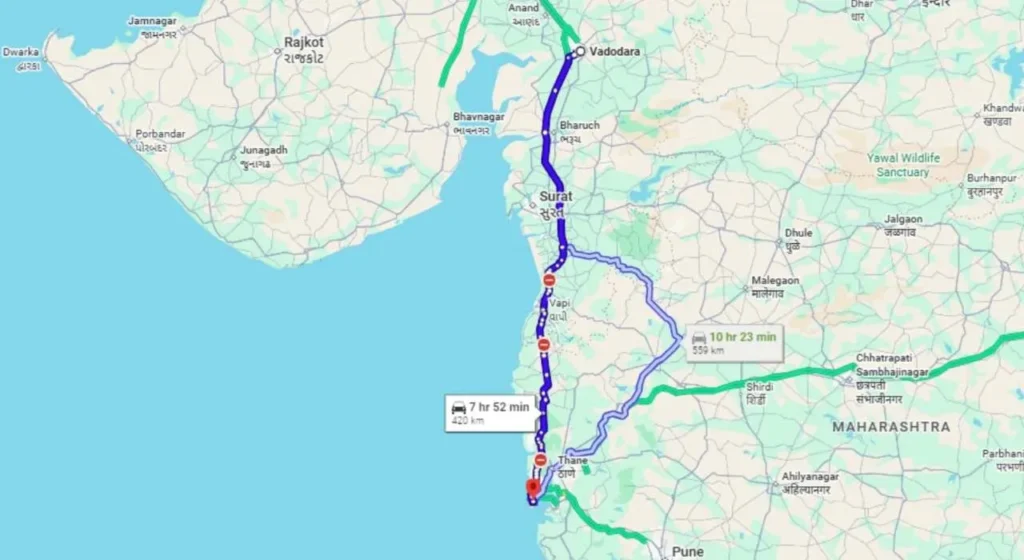
The Mumbai Vadodara Expressway Route is a masterpiece of the modern infrastructure, 379 km long, that is at present partially launched and changing the connectivity in the western part of India. This eight-lane access-controlled highway (which may be expanded to twelve lanes) is part of the highly-regarded Delhi-Mumbai Expressway, and it is an investment of India in developing quality infrastructure. The expressway was started on March 8, 2019, as a part of the Bharatmala Pariyojana project, on the NH-8 route, but radically increases the efficiency of travel.
The Mumbai-Vadodara Expressway Passage, connects the states of Maharashtra, Gujarat, and the Union Territory of Dadra Nagar Haveli in an economic road, which has earned innumerable industries as well as societies. This project has about 90 km of road made as 6 lanes and most of the highways are made as eight-lane highways and represents the ideal combination of engineering and design work.
You Might Explore: Ganga Expressway Route Map
Key Features & Benefits
- Time Savings due to dramatics: The time spent in traffic was additionally cut down by 10-12 hrs to 3.5-5 hrs.
- Distance Optimization: The route was reduced by 550 km down to 379 km and saved precious time and fuel.
- High-Speed Design: Designed to have a 120km/h speed limit across the route.
- High level of safety: Boundary walls excluding entry of wildlife, emergency crossovers at every 5 km.
- Modern Infrastructure: 24 flyovers, 14 interchanges, 76 vehicular underpasses.
- Bridges galore: 29 large bridges and 88 small bridges which guarantee easy connectivity.
- Extensive Facilities: 26 wayside, 8 truck parking, 129 pedestrian underpasses.
- Toll Efficiency: 34 toll plazas (2 main and 32 on ramps) in closed type of a system of tolling.
- Environmental Planning: 12m wide median and earthen shoulder and green buffer strip.
- Future-Ready: Infrastructure constructed with room to scale with an increasing traffic demand.
Vadodara Mumbai Expressway Cost
- Project Investment in total: ₹44,000 crores of the entire Vadodara-Mumbai section.
- Hybrid Annuities Model (HAM): New funding model that involves the merger of EPC and BOT.
- Government Provisions: 40% of the cost in installments, which are based on the milestones.
- Contractor Investment: Remain 60% made by appointed contractors.
- Toll Revenue System: There are a number of different collection points that guarantee the stable stream of revenue.
- Toll of Light Motor Vehicle: ₹500-600 between large toll plazas.
- Commercial Vehicle Charges: ₹500 to ₹1,685 in a variety of vehicle categories.
- Annual Adjustments: Toll charges will be adjusted every year according to the NHAI guidelines.
- 18 Construction Packages: Breaks down into manageable segments in order to be used effectively.
- Economic Multiplier: The investment that is likely to produce many times back its returns with the growth of the industry.
Vadodara Mumbai Expressway Impact On Real Estate
- Property Surge: 15-40% growth over the 3-5 years in the areas of the corridor.
- 30% Increase in demand: Real estate demand soaring between related districts.
- Top Investment Destinations: Vadodara, Surat, Bharuch, Navsari, Valsad, Daman, Thane, Palghar.
- New Town Boom: Large developers that are implementing integrated residential projects.
- Growth in Commercial Real Estate: Warehouses, Logistics parks, IT centers, retail complexes cropping up.
- Infrastructure Spillover: Better roads, water, electricity in the neighbourhood.
- Employment Magnet: The housing and commercial space demand is being stimulated by employment.
- Connectivity Premium: Properties that are located within expressway exits with 20-30% price premiums.
- Tier-2 City Transformation: Cities such as Navsari and Bharuch receiving a record investment.
- Developer Interest: The major real estate firms are scouting out land along the route.
- Affordable Alternatives: Areas that are served by expressways and that are affordable in comparison to Mumbai proper.
Mumbai Vadodara Expressway Route & Direction (Detailed)
Start & End Points
The Route of Mumbai Vadodara Expressway started its operations near Virar, Palghar district, Maharashtra and this is planned to be used by the Mumbai Metropolitan Region. On this initial site in one of the vibrant economic regions in India, the expressway cuts across various terrains such as the coastal plains, industrial belts and agricultural lands before it ends at the terminus of the expressway, which is Vadodara in Gujarat. Baroda or Vadodara is the cultural capital of Gujarat and an important industrial centre.
This junction is a natural extension of the north-most parts of the Delhi-Mumbai Expressway and the Ahmedabad-Vadodara one, which make Mumbai Vadodara Expressway Route an important part of the national highway network in India. The strategic location is guaranteed to have the optimum economic impact with millions of daily commuters and commercial vehicles served.
Major Cities & Junctions Along the Route
The Mumbai Vadodara Expressway Path crosses many of the major cities and areas, establishing an unparalleled connection:
Maharashtra Section:
- Mumbai Metro Area: Ports, airports and business hubs.
- Virar: fast developing suburb that is the entrance to the expressway.
- Palghar: New commercial and residential development in boom.
- Manor: Tactical city enjoying enhanced accessibility.
- Thane: Big industrial and residential powerhouse.
- Navi Mumbai: The Planned city connected to the JNPT Port.
Union Territory – Dadra and Nagar Haveli:
- Areas where there are many manufacturing and processing plants.
- Buffer in strategy between Maharashtra and Gujarat.
Gujarat Section:
- Valsad: Major industrial city whose business is expanding.
- Navsari: Ancient city in the process of modernisation of infrastructure.
- Surat: Indian capital of textiles and diamonds, the fastest-growing city.
- Bharuch: Major plants ofthe petrochemical and industry.
- Vadodara: A cultured city with different industries and educational institutions.
Industrial Zones Connected:
- Doda, Fajapur, Samiyala, and Laxmipura industrial areas.
- Dehgam, Moti Naroli, manufacturing belts.
- SEZs around Areas east of Navsari and Valsad.
Route Direction & Connectivity
- Orientation: North-south corridor of Vadodara and Mumbai.
- Similar to NH-8: Travels along the current highway but with better infrastructure.
- Port Connection: Direct connections to the port of JNPT Mumbai and the port of Dahej Gujarat.
- Airport Access: Services major airports in Mumbai, Surat, Vadodara.
- Multi-Modal Integration: Proximity to railway stations with easy transfer services.
- Urban Bypass Design: Does not create congestion at the center of the cities and is still accessible.
- Industrial Corridor: Strategic access to manufacturing areas and SEZs.
- Rural Development: Provides links between villages and small towns and urban possibilities.
- Service Roads: Service roads in required locations (48km).
- Future Expansion: Growth with 100m/120m ROW.
Speed Limit on Mumbai Vadodara Expressway
| Vehicle Type | Maximum Speed Limit |
|---|---|
| Light Vehicles (Cars, Bikes) | 120 km/h |
| Heavy Vehicles (Trucks, Buses) | 80 km/h |
| Enforcement / Variations | As per posted signs |
| General Note | 120 km/h designed speed |
- Design Speed: 120km/h across the full length of the expressway.
- Global Standards: Speed limits that are in line with those in other global expressways.
- Safety Features: State-of-the-art traffic control that provides high-speed travel.
- Electronic Monitoring: Speed cameras that guarantee speed and safety.
- Weather-Adjustments: Adjusting limits when the weather is unfavorable.
- Vehicle Category Limits: This has various restrictions to different types of vehicles.
- Emergency Response: Rapid response units are in strategic positions.
- Lane Discipline: Special overtaking lanes with safe high-speed traffic.
- Signage System: There is a clear visible speed limit indicator everywhere.
- Mechanisms of Enforcement: Patrolling and use of technology surveillance.
Is the Mumbai Vadodara Expressway Open? (Status Update)
The best news of all to travellers, part of the Mumbai Vadodara Expressway Route is already open and already serving thousands of commuters every day! It was the Vadodara to Bharuch line covering 86 kilometres and was inaugurated in February 2024, and has been an instant success with commuters who have actually felt the time-saving drama firsthand. The Vadodara-Surat is on the verge of its completion and the construction work is going very fast in various packages.
The Maharashtra section has, however, experienced a bit of a delay because of the land acquisition issue, even though some of the packages have been moving towards the finish line. The entire expressway should be in full operation by the end of 2025 or early 2026, whereby travellers will enjoy continuous high-speed connectivity between Mumbai and Vadodara, among others.
Mumbai Vadodara Expressway’s Role in the Delhi–Mumbai Expressway
The Mumbai Vadodara highway Route is the key anchor to the south of the most ambitious highway project in India, the Delhi-Mumbai Expressway, with 1350 kilometres. The purpose of this mega infrastructure is to bridge the political capital of the country with the financial one and the journey that would have taken 24 hours will take a staggering 12 to be completed. The Vadodara-Mumbai section of the Delhi-Mumbai Expressway (approximately 28% of the entire length of the Expressway) is at the heart of this vision of seamless national connectivity.
When it is finished, passengers will travel between Delhi via Haryana, Rajasthan, Madhya Pradesh, Gujarat and Maharashtra via world class infrastructure and they will not see a single traffic light. This integration will make the Mumbai Vadodara Expressway an economic highway on a national scale connecting the economies of many states and improving India as an economic giant in the world.
Vadodara Mumbai Expressway: Contact Information
- Project Authority: National highways authority of India (NHAI).
- Regional Office: the CGM & RO, Mumbai, Maharashtra.
- Full Address: 4 th floor, MTNL Telephone Exchange Building, in front of CBD Belapur Railway Station, CBD-Belapur, Mumbai-Navi City-400614.
- Primary Contact: 8130006058
- Landline Numbers: 022-27564100, 022-27564300
- Email: romumbai@nhai.org
- Types of Queries: Feedback, complaints, toll, route details.
- Emergency Call: 24/ 7 road services.
- Website: Visit NHAI official portal to get the latest information and announcements.
- Social Media: NHAI real-time traffic and construction updates channels.
Conclusion
The Mumbai Vadodara Expressway Route is not a simple concrete and asphalt construction, it is a revolution that is changing the future of western India. This expressway opens up prosperity to millions of people by linking two economic giants with world-class infrastructure. The advantages of this include lower logistics expenses to businesses, increased time saved by travelers, and new developments never experienced by the communities along the route.
The boom in real estate, growth of industry and the better living standards indicate the existence of the far-reaching effects of the project. The Route of Mumbai Vadodara highway is one of the evidences of the Indian infrastructure revolution and determination to advance as we head towards full completion in 2025-2026. Whether you are planning to take your next trip, thinking about investing money or just enjoying engineering excellence, this expressway is the way to a better tomorrow in India.
FAQs
What is the exact Length of Mumbai Vadodara Expressway Path?
The Mumbai Vadodara highway is an estimated 379-kilometre route, located between Virar in Maharashtra and Vadodara in Gujarat. It is a huge distance cut when compared to the current route of 550km, which saves time and fuel for the travellers.
What are the overall advantages of the route of Mumbai Vadodara Expressway ?
The expressway not only saves about 30% fuel, delivers high-quality safety features, connects major industrial and business centres, but also allows travel at a high speed of 120 km/h in a comfortable environment; it shortens what used to take 10-12 hours to 3.5-5 hours.
What is the timeframe of the completion of the Mumbai Vadodara highway Path?
It is projected that the entire Mumbai Vadodara highway Route would be fully operational by the end of 2025 or early 2026. Nowadays, the Vadodara-Bharuch stretch (86 km) is already operational, and the other sections are also under completion.
What does it cost to get to the Vadodara Expressway Route in Mumbai?
Depending on the type of vehicle, the Toll charges may vary between ₹500-600 (light motor vehicles) and ₹1,200-1,685 (heavy commercial vehicles) per the full route. The expressway operates on a closed type of tolling system which uses FASTag to collect it efficiently.
What is the influence of the Mumbai Vadodara Expressway Route on property price?
The Mumbai Vadodara Expressway Path has been the stimulus of 15-40% growth in the value of the property in the areas along the route within 3-5 years. The demand in connected areas such as Vadodara, Surat, Bharuch, Navsari, Valsad, Daman, Thane and Palghar has grown by about 30% and property around exits is fetching high premiums.