


In the modern competitive world of real estate business, it is crucial to make informed, data-driven decisions and not be based on gut feelings or the assumptions of the market conditions that existed many years ago. Whether you are a business investor and you are doing a multi-million dollar property analysis, a house flipper trying to find an opportunity, an agent in real estate working with clients, or an individual first-time homebuyer trying to learn the neighborhood dynamics, the appropriate real estate market analysis tools can help you turn raw data into actionable intelligence that is going to yield profitable results.
The ecosystem of real estate market analysis has changed significantly during the last decade and transformed the way professionals and individual investors can estimate the value of properties and research the market. There are no longer those days when gut feelings and simple comparative market analysis were enough to make investment decisions. The modern instruments utilize giant databases with millions of property records, advanced machine learning models, and real-time data streams to offer detailed insights that were previously only available to deep-pocket institutional investors with full-time research staff.
These resources are the democratization of enterprise-level commercial solutions that cost tens of thousands of dollars per year, to open-source market intelligence that is provided by major real estate firms at different degrees of depth, specialization, and analytical complexity. It is not about locating data; it is about locating the suitable data in the form that will fit your needs and level of experience.
The tasks regarding the selection of the appropriate real estate market analysis tools are dependent on the following critical factors which must be taken into consideration by every investor or a professional: what aspect of investment you are primarily interested in (commercial or residential property), available capital and budget of the required tool, technical knowledge and level of comfort with data analysis, and the necessary type of analysis such as forecasting, lead generation, or research into property ownership.
There are those who are very good at helping to predict the future market trends based on predictive models, and those who are oriented towards ownership identification to source off-market deals or lead generation to launch active acquisition strategies. It is vital to know the strengths, limitations, best uses, and pricing of each tool to create an efficient toolkit to analyze your data and not destroy your budget.
Also Explore: High DA/PA Free Business Listing Sites
1. ATTOM Property Navigator
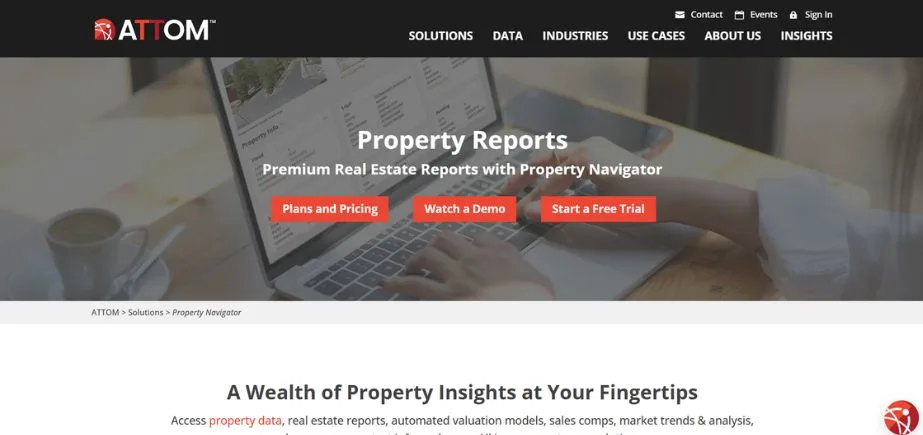
ATTOM Property Navigator is the most versatile real estate market analysis tools in delivering data intelligence on 150+ million properties in the United States, available to residential and commercial real estate professionals who require more than just listing information. The platform is also successful as it provides highly detailed property information, such as foreclosure activity, automated valuation model (AVMs), and rich comparable sales reports, without necessitating the level of investment that is needed by institutional platforms.
Users are able to create very detailed exportable property lists that are ideal for the selection of a specific marketing campaign, including rental AVMs and important environmental information such as flood zones and natural hazard analysis. This is especially useful to investors and brokerages that require access to knowledge of a high level yet find the gap between the free public records databases and the prohibitively costly institutional research services to be very wide, providing professional-quality intelligence at affordable prices.
Pros:
This is a low-cost entry point to serious data access; it includes all the features needed by investors and agents; the data export features are robust, suitable for marketing and analysis.
Cons:
Lower-tier plan report and export restrictions may be limiting; no advanced analytics, as well as their top-tier institutional counterparts.
Website:
https://www.attomdata.com
2. CoStar Market Analytics
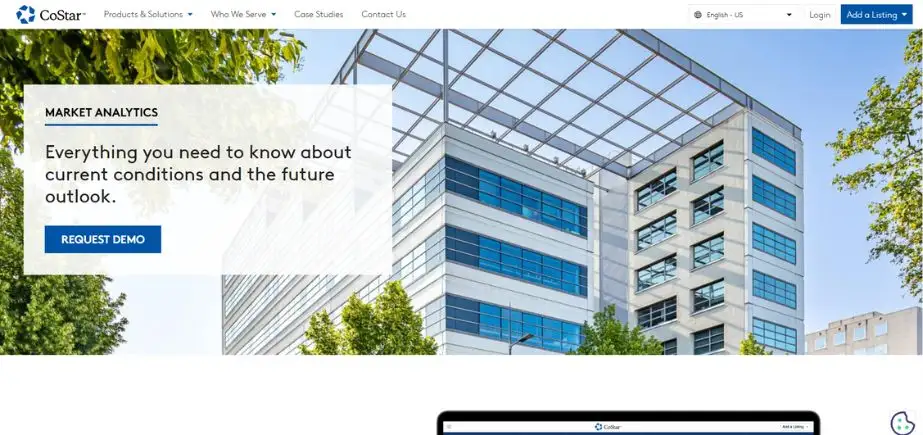
CoStar Market Analytics is the uncontested institutional quality gold standard of real estate market analysis, relied upon by the most advanced investors and lenders in the industry. The platform includes a comprehensive coverage of millions of commercial properties and keeps tens of millions of sales and lease comparables of sales and lease comparables, well-vetted, in all the major types of properties. The enormous research department at CoStar has verified and revised data by personally communicating with market participants, and provides unmatched precision in making investment decisions of millions of dollars.
Users can get full market and submarket performance information, such as vacancy rates, rental trends, absorption statistics, and detailed new construction pipeline information, and this is complemented by strong forecasting models that drive the future market conditions. The tailored reporting features and in-depth commentaries of the analyst make the platform invaluable to commercial investors, professional appraisers, institutional lenders, and brokers who need the most credible and defensible information in the market.
Pros:
The unparalleled depth of validated CRE information in all property departments; strong forecasting designs that incorporate scenario analysis; a flawless combination with finely granular property-level information.
Cons:
prohibitively priced to individual investors or residential-oriented agents; laser-guided on commercial assets, not residential.
Website:
https://www.costar.com/products/market-analytics
3. CREXI Intelligence
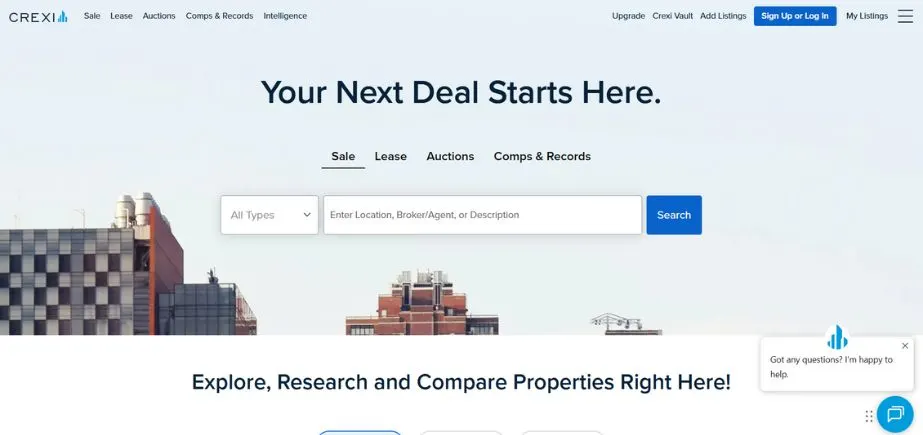
CREXI Intelligence is a blend of 360 commercial real estate market analysis tools and an active marketplace platform, which forms an ecosystem of rapid brokers and investors. The overall tool offers wide access to more than 150 million property records and millions of detailed sales comparables to enable users to authenticate investment opportunities using hard data immediately without moving across various platforms.
The feature that CREXI has over competitors is its advanced interactive mapping capability, which superimposes essential contextual data such as traffic and population trends, income rates, and the physical aspect, such as flood zones, on property data layers directly. This integration removes the time-wasting confusion of having to switch between dissimilar platforms in time-sensitive research phases, in which the flow of work that begins with the identification of the opportunity, then due diligence, and the final execution of the deals, with all the intelligence required, can be performed in a centralized location.
Pros:
simple open pricing of basic analytics package; very practical map layers with handy overlays; direct connection to the active commercial marketplace of deal flow.
Cons:
Data completeness might not be one of the best on the dedicated platforms in smaller asset markets; The price of the PRO plan can be dramatically different depending on usage.
Website:
https://www.crexi.com
4. HouseCanary

HouseCanary is amongst intensely technologically advanced real estate market analysis that combines the best automated valuation models (AVMs) technology with the force of predictive forecasting technology that goes way beyond comparable sales analysis. The platform is used by institutional investors, mortgage lenders, iBuyers, and progressive brokerages who want more than superficial data on the market and must incorporate a complex valuation process directly into their operations. Its robust API access allows large-scale processing of data with ease because it is indispensable to investors who manage large portfolios or brokerage services that require processing hundreds of valuations all at once.
The forward-thinking market acumen provided by CanaryAI and the comprehensive market perspective that the platform offers give the type of predictive vision that is highly important in navigating through the unpredictable and quickly shifting housing markets with a sense of confidence and accuracy. Clear-grade pricing systems support individual property report analysis down to a single asset and API access to enterprise business at the highest level.
Pros:
Powerful valuation and forecasting models based on proprietary algorithms; special services with a specific focus on brokerages and institutional customers; transparent pricing levels with specific features distinction.
Cons:
Only covers the residential market, not commercial property; lower subscriptions can charge high extra per-use costs for premium functionality.
Website:
https://www.housecanary.com
5. LoopNet
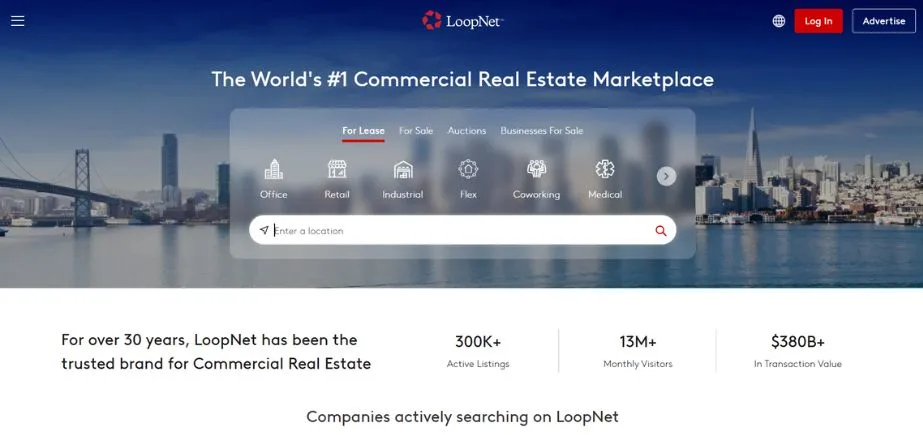
LoopNet is one of the largest and most recognized commercial real estate market analysis that successfully links buyers, sellers, tenants, and landlords throughout the United States on an unparalleled scale. The platform offers superior visibility to commercial properties that require as much exposure as possible in the market through strategically developed tiered advertising packages, including Silver, all the way to Platinum and Diamond levels. Although its analytical features are undoubtedly less refined than specific institutional research solutions, the real-time intelligence provided by market absorption rates, active listing analysis, and trending current asking prices provides an invaluable insight into particular submarket dynamics and buyer behavior.
The large base of qualified prospects that LoopNet provides property owners and brokers with a massive ability to reduce the lease up time frames and sale velocity by order of magnitude, making LoopNet an indispensable marketing instrument to any serious person in the process of selling commercial assets and/or leasing them out in markets where visibility is directly proportional to both the speed of the lease up process and the pricing influence.
Pros:
Unrivaled access to huge qualified audiences to expedited lease and sale cycles; customizable listing packages with adjustable marketing solutions; superior means of measuring the current market activity and pricing dynamics.
Cons:
Compared to specialized institutional research suites, analytics capabilities are limited, and premium listing placement and improved visibility can be rather expensive to buy soon.
Website:
https://www.loopnet.com
Read More: Best States to Buy a Home in USA
6. Moody’s Analytics CRE
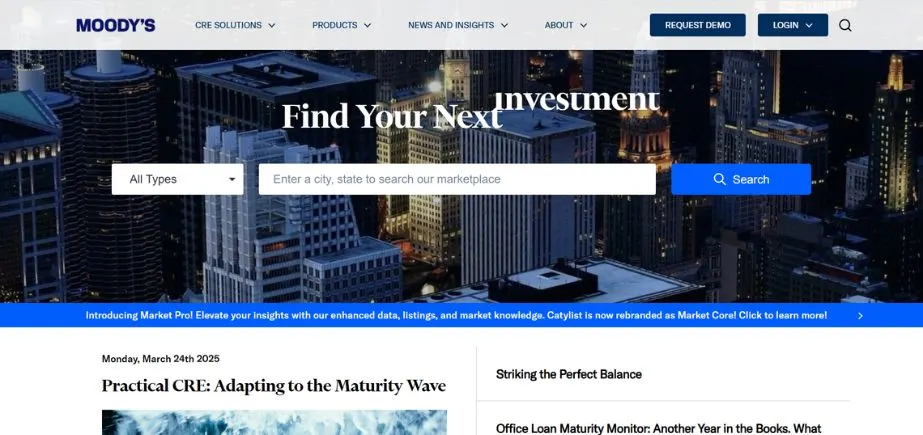
The Moody Analytics CRE reckons its legendary and tested financial modeling and forecasting software in a specified application to the analysis of commercial real estate, which forms a true juggernaut of a platform in complex underwriting procedures and long-term strategic planning initiatives. The site separates itself vis-à-vis its rivals by the intelligent combination of sophisticated economic scenario modelling, total CMBS (Commercial Mortgage-Backed Securities), loan information, and advanced climate risk overlays into refined forward-looking forecasts that estimate performance in many possible futures.
Such an exceptional and distinctive combination enables institutional investors, capital market professionals, and conservative lenders to stress test their entire portfolios against both conventional financial risk factors and the growing, increasingly relevant environmental factors in their overall perspective on long-term asset robustness and susceptibility. Moody has a particular advantage of making predictions of how the market will perform in different probable economic conditions and scenarios, instead of merely reporting current snapshot measures, and intensely qualitative analysts’ stories complement quantitative models to provide the necessary background, which is crucial in deciding the multi-million dollar allocation in capital investments.
Pros:
Outstanding forecasts and with various scenario modelling; distinctive and valuable combination of climatic hazard evaluation and CMBS data; profound analyst commentaries that show market background and clarification.
Cons:
Pricing model is not as transparent, and it is definitely targeted at large institutional customers; it only allows CRE, which makes it entirely inappropriate to use in residential.
Website:
Homepage
7. MSCI Real Capital Analytics (RCA)
The Business MSCI Real Capital Analytics is specifically dedicated to the specific and purposefully aimed tracking of the capital flows and the dynamics of the complex transactions in the commercial real estate markets over the territory of more than 170 countries all over the globe. Instead of digging deeper into property-level analysis, RCA looks macro by coherently following the trends of large-scale institutional investments, the amount of transactions each quarter, their price trends, and patterns of capital allocation that influence international markets. The exhaustive database the platform covers is a complete listing of millions of commercial real estate transactions in all the major property areas and is highly competitive in offering the institutional investors, global portfolio managers, as well as market strategists, the macro-level intelligence they require to know of large market trends.
It has a highly regarded proprietary RCA CPPI (Commercial Property Price Indices), which is used as an authoritative standard of commercial property pricing dynamics in the world, and has been extensively quoted by professionals in the industry. This transaction-based form of real estate market analysis is absolutely useful when trying to determine where exactly institutional funds are moving, the emergent cross-border investment trends, and being able to properly compare the performance of the portfolio with the right market trends and against the peer groups.
Pros:
Unparalleled international data on CRE capital flows and institutional pricing trends; strong and highly regarded proprietary indices (RCA CPPI); a robust API integration support feature to custom workflows.
Cons:
A preferably high cost structure that renders it inaccessible to the majority of individual customers and smaller businesses; a very limited range of specialization with no products on offer to participants of the residential market.
Website:
https://www.msci.com/data-and-analytics/real-estate/real-capital-analytics
8. PropStream
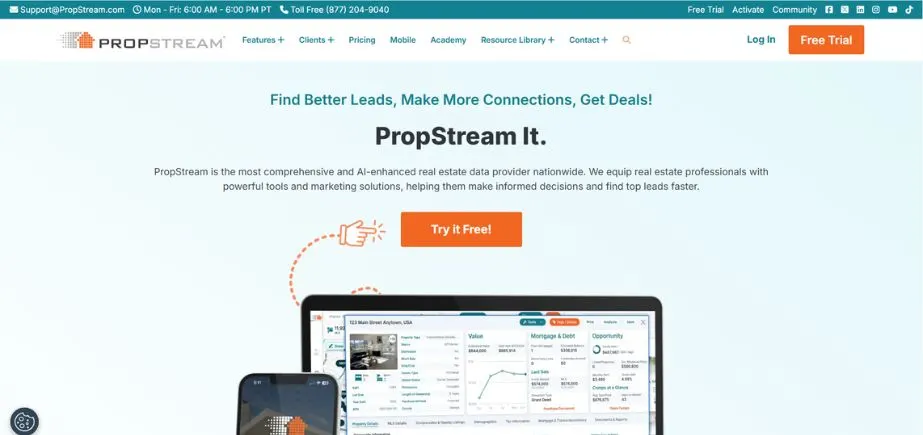
PropStream effectively integrates strong and detailed property data with strong integrated lead generation and marketing features to produce a truly action-driven platform that is for active investors in real estate, as opposed to passive researchers. Having a vast access to more than 160 million property records and boasting 165+ advanced filtering conditions, users may easily find highly motivated sellers through disclosed traits, such as the current pre-foreclosure status, high accumulated equity, absentee ownership profile, or notations of distressed property.
The site’s easy-to-use heat mapping feature helps investors find the most promising areas and new markets quickly, and the direct marketing features are also easily incorporated, so users can easily launch specific direct mail campaigns, skip tracing operations, and outreach programs right within the same platform. Such an exceptionally smooth flow in the work process, starting with the identification of the neighborhood, up to focused list building, and, finally, direct seller outreach, provides serious investors with considerable and quantifiable competitive advantages in a saturated market. Mobile app features represent extensive support in conducting vital on-the-go research and time-bound decisions when appraising properties in the field.
Pros:
Good, dedicated to the specific tools to find valuable off-market deals and distressed properties; organically blends the lead generation with full property analysis; fully featured mobile app, providing the opportunity to do all research and make decisions on the go.
Cons:
There are high-end real estate market analysis tools and skip tracing capabilities, which are charged per-use on top of the base subscription; the depth and accuracy of overall data quality can differ in some rural regions or even non-disclosure states.
Website:
https://www.propstream.com
9. Redfin Data Center
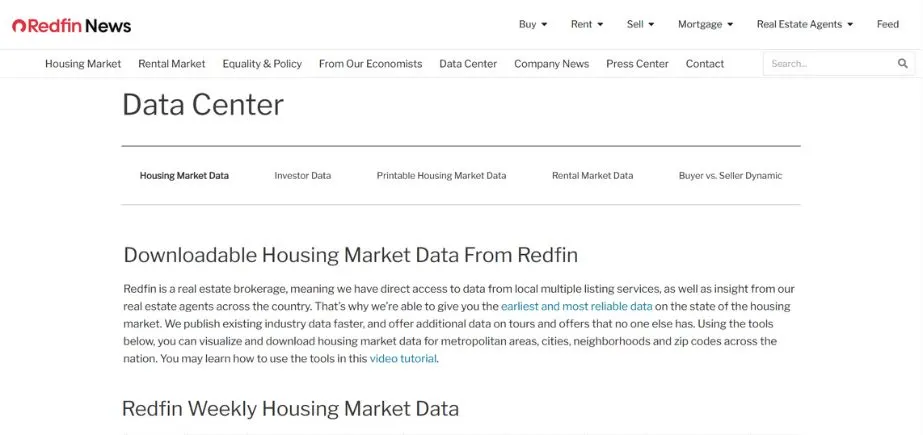
The Redfin Data Center offers fully free publicly available residential housing data, which is updated with astounding frequency on weekly and monthly schedules according to the specific measure. This is a full downloadable repository in which you can find truly granular geographic coverage that extends all the way down to state, metro, county, city, and finally individual ZIP codes, with all the key indicators such as median sale prices, active inventory levels, days on market, and key sale-to-list price ratios that indicate market momentum.
The much quicker rate of publication of the platform relative to other conventional government data providers, such as the Census Bureau, offers shrewd users considerably more up-to-date and responsive market snapshots, allowing them to promptly determine the velocity changes and changing consumer behavior patterns. Clean, well-structured datasets can be downloaded freely by real estate agents, data-savvy investors, market journals, and professional analysts to do entirely custom analysis at no subscription or access fees, democratizing access to market intelligence that used to be hard to access consistently.
Pros:
No cost whatsoever to access timely high-frequency data on residential markets; easy-to-understand, transparent methodology, and convenient definitions of data; covers a remarkably wide geography down to the level of a particular ZIP code.
Cons:
Data is mostly derived based on Redfin brokerage activity itself and partnered MLS feeds, which are inherently updated on a periodic basis; may not capture all the transactions in the market, especially individual sales.
Website:
https://www.redfin.com/news/data-center
10. Reonomy by Altus Group
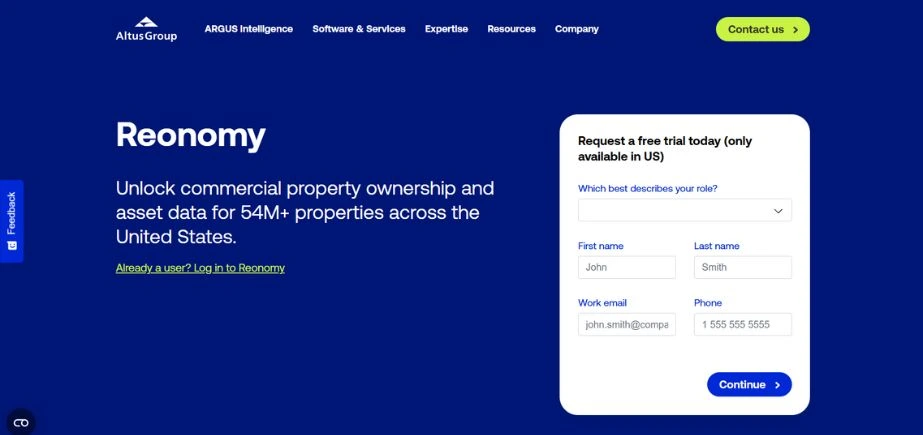
Reonomy is a one-year-old firm that focuses exclusively on discovering valuable off-market commercial real estate opportunities in a systematic manner based on the acquisition of ownership intelligence through the most advanced means and the compilation of property-level data. The most effective and famous feature of the platform is to cleverly and skillfully deanonymize complex ownerships concealed behind LLCs, trusts, and other business entities, cleverly linking seemingly distant properties to determine complete collections owned by a single advantageous owner or a networked collection of entities.
Such a transparency in ownership is simply priceless to commercial brokers, opportunistic investors, and specialized service providers who are actively seeking direct access to real decision-makers as opposed to wasting time with property managers or middlemen. Having over 200 highly customizable filtering options in its vast database of 54 million properties, users can effectively narrow in on hyper-specific investment opportunities on the basis of complex factors such as current loan-to-value ratios, particular opportunity zone location, or the current age and condition characteristics of a property, or ownership tenure pattern that indicates a potential motivation to sell.
Pros:
Industry-best ownership unmasking abilities and allow extremely targeted outreach; customizable data delivery through either an easy-to-use web application, powerful API, or bulk data feeds.
Cons:
No pricing information is publicly available, so when prospective customers are determining an accurate budget, it can be challenging; coverage of data across regions and predictability can differ greatly depending on the market and region in question.
Website:
https://www.altusgroup.com/solutions/reonomy
11. Yardi Matrix
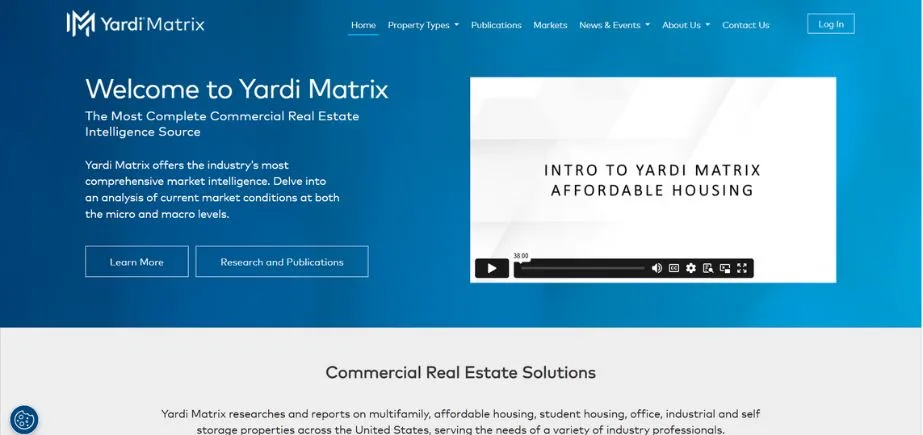
Yardi Matrix provides extremely specific and industry-oriented intelligence on the multifamily apartment buildings, student housing developments, and affordable housing properties with very exceptional levels of granularity and operational detail. The fully integrated platform contains essential property-level operational information, such as carefully monitored rent and occupancy comparables of similar properties, construction pipeline tracking with estimated delivery dates, and valuable direct owner and property management contact information to use in networking and deal sourcing. Users can easily find out the existing mortgage loan data with specific maturity dates and up-to-date loan balances, thus allowing advanced capital stack analysis and identification of refinancing opportunities.
The specialized operational orientation has indeed helped Yardi to stand out of the more general-purpose market structures in that it gives apartment developers, multifamily lenders and property owners the high-resolution granular data that is indeed needed to gain insight not only in the general market but in specific key players, management practices, and underlying financial structures that are actively at work to drive performance in their respective markets and competitive groups.
Pros:
Unmatched depth in data relating to the multifamily and affordable housing sector; contains useful hard-to-find operational information such as owner contacts and comprehensive loan information; and issues regular thought-provoking market reports.
Cons:
Prices are highly tailored and entirely non-transparent, which makes the sales process take a long time; coverage of the market may be significantly reduced when it comes to the asset classes that are not the primary focus of the typical multifamily.
Website:
https://www.yardimatrix.com
12. Zillow Research Data
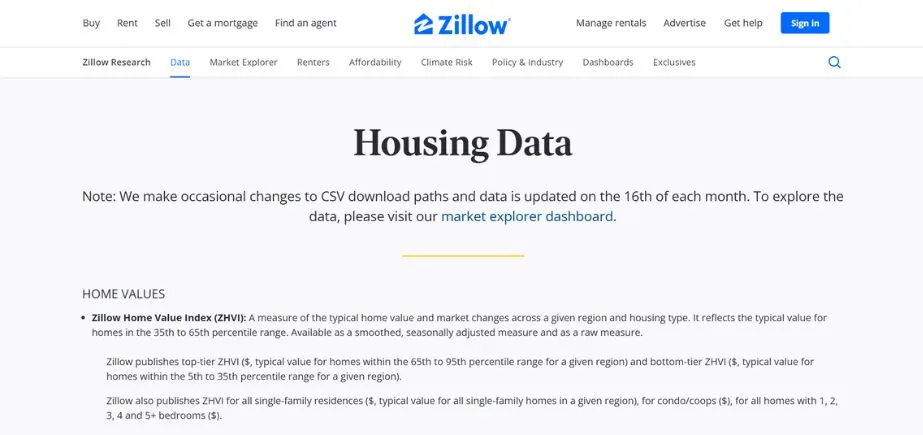
Zillow Research Data freely provides fully downloadable datasets that it has directly used to drive its own widely-read market reports, indices, and research publications, which it publishes publicly. It is a great library of public data with highly aggregated time-series data and a complete picture of residential home values, rental price trends, inventory level changes, and sales volume forecasts in an incredibly broad geographic focus across all parts of the United States. The data is easily accessible and available to users as clean analysis-ready CSV files by specific metro areas, individual counties, or even down to the granular zip code, so that advanced custom modeling is possible, analysis of long-term trends can be done with rigor, and academic research can be done without any financial limitations.
The true utility of the platform is that it offers the crucial macro-level market data and aggregate statistics as opposed to more detailed information about properties or transactions, which is why it is best applied in quantitative research, investigative journalism, scholarly research, and complementary proprietary commercial analysis with credible background information. Detailed and clear documentation of methods used in methodology assists the users well in understanding how data is constructed, what its limitations are, and how to apply them to ensure research integrity.
Pros:
Full access to vast and frequently updated national data on housing free of charge; striking geographic granularity up to individual ZIP code level; full transparent documentation of methods.
Cons:
It has no individual property-level data, such as individual ownership or transaction information; it is not transactional, but instead aggregated; methodologies sometimes evolve, so that a user has to watch out.
Website:
https://www.zillow.com/research/data
How to Select the Right Real Estate Market Analysis Tools
To choose the right and efficient real estate market analysis tools, you have to provide an honest and proper evaluation of your particular investment goals and objectives, realistic budget limitations, current technical abilities, and intended application. Those commercial investors who are regularly evaluating institutional-grade deals in the millions of dollars will naturally be drawn to more business-friendly portals such as CoStar, MSCI RCA, or Yardi Matrix at their great cost, and residential flippers and wholesalers will be attracted to the easier-to-use tools such as PropStream or ATTOM Property Navigator.
In the meantime, the entirely free data sources such as Zillow Research Data and Redfin Data Center serve as a great and valid starting point for data analysts, scholars, and people who are familiar with spreadsheet analysis and do not have significant funds to obtain the tools at present.
Thoughtfully determine whether your core requirement revolves around granular property-level intelligence, general market trend analysis and projection, specific ownership data in prospecting, or integrated lead generation in active deal identification. Others are more effective at economic forecasting and predictive modeling, whereas others are more focused on ownership research and prospecting, or more effectively integrate marketing automation.
The final decision that you make should be pretty consistent with the way you work in practice, on a daily basis. Even the most technically advanced and feature-rich tool will be virtually useless in your day-to-day workflow, unless its complexity, steep learning curve, or intractable interface allows you to put it to productive use on a regular basis.
Budget considerations are a very important and, in most cases, deciding factor in the process of selection. Enterprise level solutions are, by all measures, unmatched in the depth of data, verification, and sophistication of the analysis, but they need very large continuing financial investments that can only be justified by the fact that exceptional granularity and reliability directly affect the quality of decisions made on large transactions where even a small percentage improvement in the outcome translates to large dollar values.
A number of successful specialists note that a carefully chosen mid-tier paid platform, plus a number of auxiliary free data sources used strategically, can form an effective, well-rounded, and rather cost-effective set of analytical tools.
Future Real Estate Market Analysis
The landscape of real estate market analysis remains changing at a rapidly growing rate, as new applications of artificial intelligence, advanced machine learning algorithms, and alternative sources of data radically increase the number of possible analytic tools and predictive power. Climate risk assessment application, walkability and transit score, school quality data, and sophisticated predictive algorithms using non-traditional data are quickly turning into the features of the expected level, instead of the high-end option that can only be accessed on the enterprise level. Data access through robust API and state-of-the-art integration features is increasingly becoming important as forward-looking professionals develop custom analytic piping in a systematic manner and integrate various complementary sources of data into a single intelligence platform.
There is no success in the current real estate game without an incredibly greater amount of real estate market analysis tools and access to data that would provide the edge but it would be the ability to analyze the data properly and correctly, the understanding of the market that would allow one to put the findings into the proper context, and the professional judgment that would allow one to act on the insights as the opportunities arise.
The advanced platforms mentioned in this guide give you the raw material and the starting point of knowledgeable decision-making, yet, in the end, all of your gathered knowledge, experience in the market, and decisional judgment turn abstract data into highly lucrative action results and competitive edges.
It may be your first small investment, or you are in the business of managing a multi-billion dollar institutional portfolio, but it is the proper and well-chosen market analysis tools that give you the much-needed clarity, confidence, and competitive intelligence to maneuver successfully in an ever-more complex transaction in the dynamic markets.
The first steps that can be taken are defining your particular needs and limitations clearly and honestly, using possible free trials and platform demonstrations when possible to check them in real hours, and creating a complete toolkit that will suit your unique goals without breaking your budget. The initial investment into quality market intelligence systems will always reward heavily through improved decision-making, avoidable mistakes that are costly, and opportunities founded on quality insights that other less informed competitors will never see at all.
Frequently Asked Questions
1. Which is the most effective free real estate market analysis tool?
The best free real estate market analysis tools are Zillow Research Data and Redfin Data Center, which provide downloadable data on the metrics of the market, home values, rental prices, and inventory. They are both the best in terms of their capacity to offer geographic granularity up to ZIP codes and are regularly updated, so investors, analysts, and agents can be sure that they have accurate data on market trends without the subscription fees.
2. What is the most appropriate real estate market analysis tool for commercial investors?
CoStar Market Analytics is the market standard in the real estate industry, with unparalleled confirmed data of millions of properties, entire market measures, and powerful forecasting. To provide institutional investors with financial insight into capital flows around the globe, MSCI Real Capital Analytics is the source of the necessary intelligence on transactions. CREXI Intelligence can be favored by cost-conscious specialists due to its simple pricing strategy and its built-in marketplace.
3. What are the prices of the professional real estate market analysis tools?
Pricing is highly differentiated on platforms and user requirements. There are free services such as Zillow and Redfin. The propstream tools, such as the mid-tier, begin at a price of around $99/month, whereas ATTOM and HouseCanary have affordable annual subscriptions. CoStar, Yardi Matrix, and Moody’s Analytics are enterprise products that need custom quotes and cost thousands to tens of thousands per year.
4. Is it possible to make individual investors use the tools of real estate market analysis?
Absolutely. Individual investors have access to affordable lead generation and deal-finding tools, such as PropStream, plus full property data, such as ATTOM Property Navigator, and free data on market trends, such as Zillow Research Data. These websites will give them information that was unavailable to individuals before, allowing them to make more intelligent investment choices and spot opportunities.
5. How do residential and commercial real estate market analysis tools differ?
Residential tools are oriented at individual family houses, condos, and small multifamily units where automated valuations, similar sales, and consumer market trends are considered. Condition: Commercial tools examine offices, retail centers, industrial buildings, and large multifamily buildings, and focus on the vacancy rates, cap rates, lease comps, and institutional investment flows. There are services that cater to both of the markets, such as ATTOM.
Continue Exploring: Best AI Tools for Real Estate Agents to Close More Deals