


The past few years have seen the real estate sector experience a ground-breaking change, and artificial intelligence is a disruptive technology that has transformed the way properties are sold, managed, and marketed. By using AI tools, real-estate professionals are achieving important competitive benefits in 2026, both automating much of the routine workflow and producing eye-catching graphic content, and refining leads with greater accuracy than ever before. The use of AI in the workflow of real estate is not just utilized experimentally anymore, but is placed in the realm of the necessity of modern practice.
The current AI-based solutions cover almost every part of the real estate business cycle. You are either working alone as an agent and are handling dozens of listings, or you are a broker with a team, and you are managing numerous portfolios, or you are a property manager. Now, there is an AI solution to streamline whatever you are going through. These technologies are not substituting the intelligence of humans but, on the contrary, help the professionals to concentrate on building relationships and making strategic decisions, leaving the time-consuming administrative tasks to AI.
This is a complete guide to the top 10 AI Tools Transforming the Real Estate Market. Each platform has its distinct features, which are meant to address certain pain points that real estate professionals go through in their day-to-day lives. Call tracking, call analytics, workflow automation, and automatic content creation are just some of the innovations that will be the pinnacle of what can be done when intelligent technology intersects with real estate experience.
Top 10 AI Tools Transforming the Real Estate Market
1. CallRail
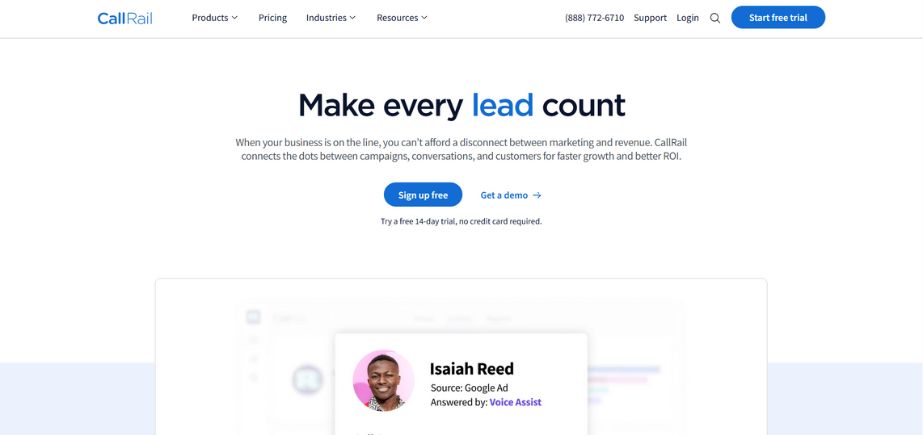
CallRail is an excellent example of a call tracking and analytics system that allows real estate agents to know which marketing initiatives, in particular, result in phone calls. The platform applies AI to process call utilization, conversation transcription, and quality lead identification. In the case of real estate agents with many marketing aspects, such as online marketing, social media advertisements, and offline advertisements,
CallRail offers an understanding of ROI by tracing each phone call to its origin. The conversation intelligence capabilities of the system are able to recognize keywords and sentiment, and can make an agent aware of what prospects really need and the performance of their team to effectively respond to inquiries.
Key Features:
- Call transcription and sentiment analysis with AI.
- The attribution tracking of all marketing campaigns through multi-channel.
- Conversation-quality lead scoring is an automated process.
- Call coaching and real-time monitoring of the calls.
- ROI of marketing is displayed in detailed analytics dashboards.
Best for:
Real estate teams and brokerages that rely on phone call requests need to put in place the funds for marketing.
What the AI actually does:
Transcribes the cell phone calls in real-time, uses sentiment and keywords to rate the quality of leads, which marketing channels yield the highest-valued calls, and provides insights into the prospect’s needs and agent performance.
Pricing model:
Tiered subscription-based plans, which start at around 45/month for basic call tracking and go up according to call volume, and require advanced functionality.
Integrations:
Salesforce, HubSpot, Google Analytics, Facebook Ads, Google Ads, Zillow Premier Agent, and big CRM systems in the real estate industry.
2. Canva
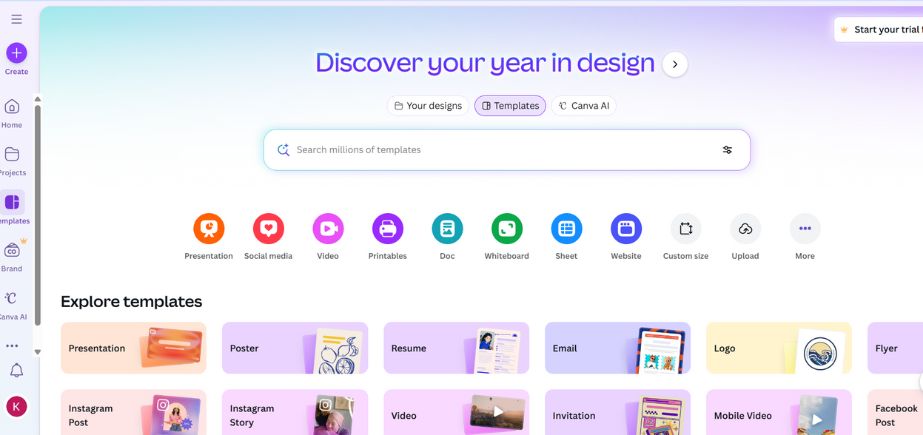
Canva has turned into an AI-driven creative platform rather than the regular design tool that no real estate marketer can do without. New AI capabilities on the platform are Magic Design, which, given some basic prompts, creates professional marketing content, and background remover, which ensures that the images of the property look exceptional.
Real estate agents are able to make all their social media postings and home flyers, as well as email newsletters and presentation materials, without the necessity of having knowledge of graphic design. The large template base explicitly has designs with real estate orientation, whereas they can be modified within minutes, with brand consistency across all channels of marketing, and hours in the design process are saved.
Key Features:
- Artificial intelligence-based design proposals and layout generation.
- Background elimination and image enhancement features with a single click.
- A large real estate template library, which may be customized.
- Brand kit options to have uniform marketing content.
- Video editing services on property tour materials.
Best for:
One needs to design quality marketing materials within a short period of time without employing designers, or when involved in small teams.
What the AI actually does:
Reading the design trends to propose layouts automatically removes and replaces the backgrounds in property photos, creates color schemes that match the listing photos, and creates entire design options based on text prompts.
Pricing model:
Freemium with a well-developed free tier; Canva Pro begins at around $15/month in case individuals have advanced AI capabilities on the platform.
Integrations:
Dropbox, Google Drive, social media (Facebook, Instagram, LinkedIn), Mailchimp, and content management systems.
3. Follow Up Boss
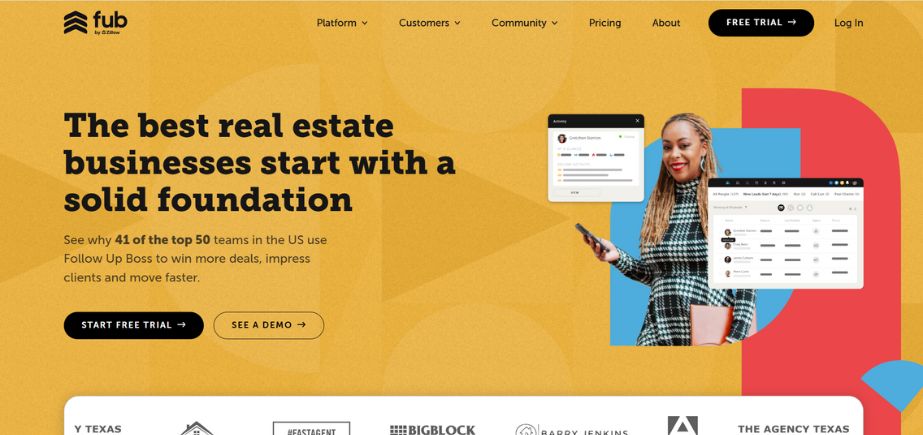
Follow Up Boss is an AI-enhanced CRM that is created specifically to serve real estate teams and is aimed at making sure that no leads are ever lost in the cracks. The intelligent routing option of the platform automatically gives leads to appropriate agents depending on specialization, availability, and performance history. It uses its AI-based insights to understand how people communicate and which leads have the highest chance of conversion, and when they are willing to take action.
The system is able to trace all contacts via email, text, and phone calls, and gives a full picture of the path of each prospect. In the situation of brokerages having numerous agents and lead sources, it provides accountability and visibility that directly translates to increased closed deals in the case of Follow Up Boss.
Key Features:
- Smart lead routing and automatic assignment.
- Neural score cards and interaction forecasts.
- All communication channels are united in one place.
- Smart-timed automated follow-ups.
- Analytics and coaching of teams.
Best for:
Real estate teams and brokerages with high volumes of leads and requiring systematic follow-up procedures.
What the AI actually does:
The AI will predict the most likely leads to convert, which leads should be contacted when, based on the engagement patterns, place the leads with the most suitable agent, and identify the at-risk deals before losing them.
Pricing model:
Subscription-based pricing with a cost of approximately 69/user/month, where volume discounts apply to a large team.
Integrations:
Zillow, Realtor.com, Facebook Lead Ads, Google Ads, BombBomb, and CallRail, as well as big real estate listing platforms.
4. LazyEditor

LazyEditor is an innovative automated video editing tool that is targeted at real estate creators. The platform employs AI to work with crudely captured property walkthrough recordings and refine them into smooth, entertaining video tours with music, transitions, and optical overlays.
All the real estate agents need to do is upload their phone footage, and the AI of LazyEditor is able to perform the gruesome editing task – trimming the dead air, stabilizing the wobbly camera work, improving the lighting and color, and even creating captions of their own. This is because with this democratization of video creation, every listing can have professional video content without having to invest time and money as before to hire videographers and editors.
Key Features:
- Auto-detecting of scenes and intelligent editing of videos.
- Video stabilization and color correction with the help of AI.
- Auto-generated captions and added texts.
- Automatic beat matching with music library.
- Multiple property video batch processing.
Best for:
Active listing agents who desire the professional video content on each property, without wasting hours on editing.
What the AI actually does:
Uses raw footage to find the most desirable shots, eliminates unnecessary pauses and errors, uses professional-grade color correction and stabilization, syncs edits with background music, and creates interesting captions to speech.
Pricing model:
Subscription-based, where the cost is usually between $29 and $99/month based on the volume and resolution requirement of video output.
Integrations:
YouTube, Vimeo, social media, and cloud storage (Google Drive, Dropbox), and MLS listing platforms.
5. ReimagineHome
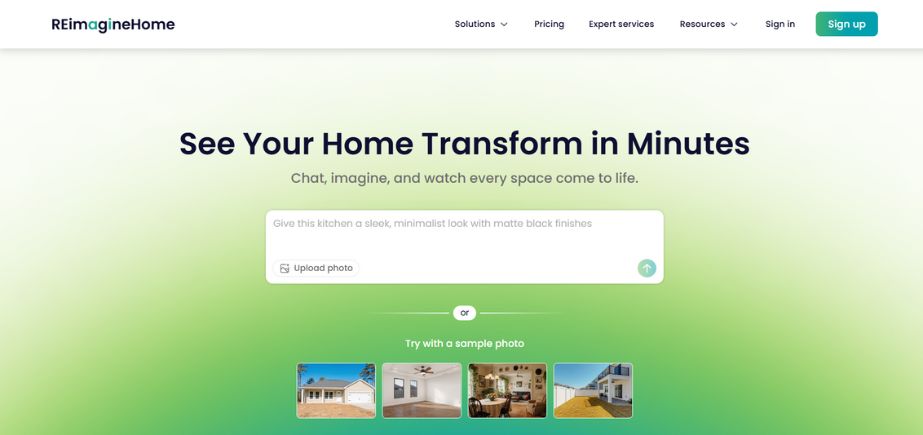
ReimagineHome is utilizing the potential of generative AI to enable buyers to imagine the potential of any house. This new platform enables real estate professionals to post photos of vacant rooms, old spaces, or homes requiring renovation, and the AI-powered platform will automatically create a photorealistic image of the room, space, or homes, but with full furnishing, modernization, or redesigning in any style.
Such a virtual staging feature is groundbreaking when it comes to selling empty houses or assisting buyers to visualize beyond the old-fashioned styling the potential of a home. The technology does not just stop at a mere positioning of furniture; it can redesign whole renovations, display alternative flooring and paint choices, and even simulate how spaces can be restructured.
Key Features:
- AI-based virtual staging across design styles.
- Real-time visualization of renovation and comparison before/after.
- Renovation of the exterior, such as the modification of landscaping.
- Several style alternatives in the room, depending on the customer, regardless of the buyer.
- MLS listing outputs and marketing outputs of high resolution.
Best for:
Agents who are dealing with empty listings or house fixers, or those clients who have a hard time imagining the potential in old spaces.
What the AI actually does:
For instance, the AI analyzes the size and lighting of the room based on photography, creates realistic furnishings and decor arrangements, redesigns architectural changes and finishes, and prepares multiple design options to suit the tastes of various buyers.
Pricing model:
Credit-based system in which users buy image credits, which are usually between 0.50-2.00 USD per image generated and are mainly based on the amount of credits being purchased.
Integrations:
MLS services, real estate visualization services, property marketing platforms, and cloud storage providers.
6. Roof AI

Roof AI is an artificial intelligence property checking and valuation with explicit roof analysis based on aerial photos and satellite positioning. It is a professional tool used by real estate professionals, home inspectors, and insurance agents that allows them to create comprehensive reports on the condition of the roof without having to step on a single ladder.
The AI measures images of the potential problems, such as missing shingles, damage patterns, wear and tear, and estimates the remaining roof life. To the agents, this is a good source of information in the listing consultation and in establishing the right expectations for the sellers on possible issues in inspecting their properties. Roof measurements are also done automatically by the technology, which simplifies the replacement quote process.
Key Features:
- Aerial view roof condition recognition using AI.
- Measuring and computing materials automatically.
- Damage identification and detection.
- Remaining life forecasts and estimation of the roof age.
- Client and inspectorable instant downloadable reports.
Best for:
Listing agents that carry out pre-listing inspections, buyer agents that carry out due diligence, and property managers who keep track of the portfolio conditions.
What the AI actually does:
Processes satellite and aerial photographs to determine the size of the roofs, wear marks, and signs of damage, age by the degradation of the materials, the duration of usability, and anomalies to consider further investigation.
Pricing model:
Per-report pricing, which generally amounts to between $15 and $50 per property analysis, with subscription solutions for large users.
Integrations:
Home inspection solutions, property management systems, insurance company systems, and contractor estimating systems.
7. Scout
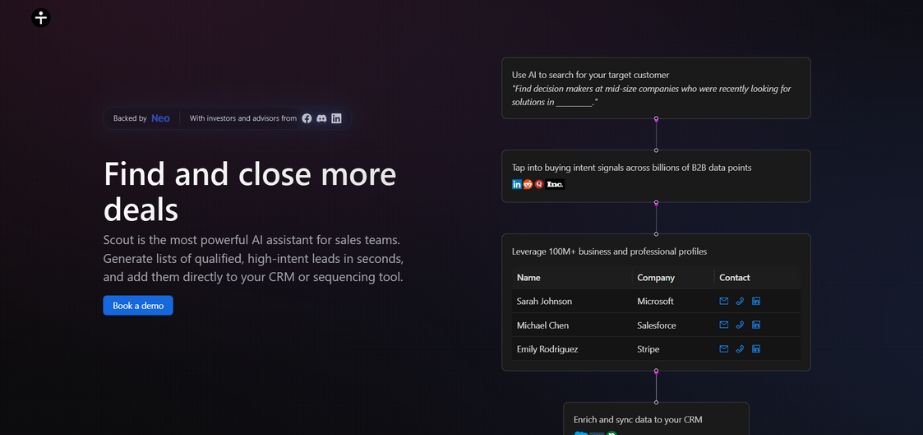
Scout is an AI-based prospecting and lead generation application that assists real estate agents in finding potential sellers prior to them listing their homes. The system will scan through volumes of publicly available data, such as property records, number of years in possession, life events, and market indicators, to determine which homeowners have the most probability of selling the home in the near future.
This forecasting will enable agents to make advances in advance with targeted messaging, nurture relationships in advance of rivalry, even when the property has not been listed in the market. The artificial intelligence of Scout works continuously, learning about the feedback of agents and the results of the market, becoming more precise with time in recognizing real opportunities and falsely identified opportunities.
Key Features:
- Anticipatory analytics of who is likely to become a seller.
- Automated enrichment of data with contact details of the homeowners.
- Individual outreach campaign recommendations according to the profiles of sellers.
- Corporation with governmental records and private information sources.
- Dashboards of territory management and opportunity tracking.
Best for:
Agents concerned with pipeline construction by proactive prospecting and not reactive response to leads.
What the AI actually does:
Integrating and analyzing various data sources to rank properties by the probability of selling, detecting trigger events such as a refinance or a change in life, determining the best time to contact a homeowner, and customizing the message to them depending on their features.
Pricing model:
Subscription-based, where pricing will vary between $99 and $299/month based on the size of the territory and the number of leads.
Integrations:
Large real estate CRM, direct mailing, email marketing, Skip Tracing, and MLS.
8. Top Producer Smart Targeting
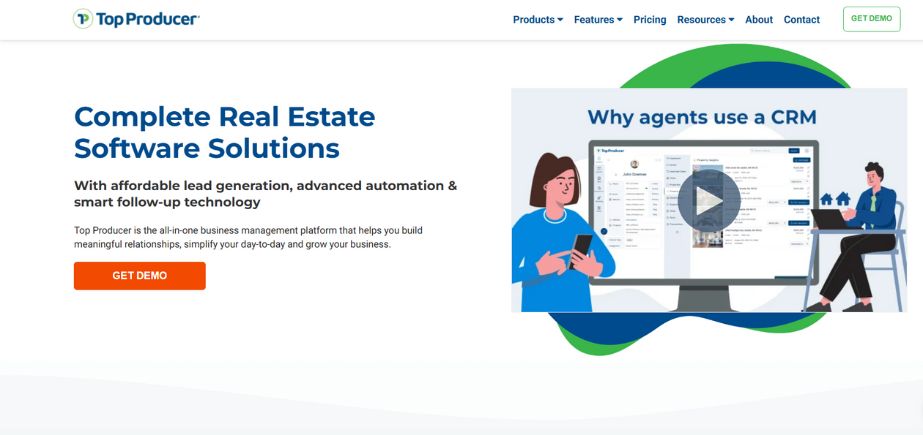
The integration of classic CRM capabilities and 21st-century AI-enhanced predictive analytics enables Top Producer Smart Targeting to promote the use of agent resources on contacts with a high likelihood of transacting. The platform uses the patterns of engagement, including the opening of emails, visiting websites, searching properties, and interaction in social media, to rate the willingness of each contact to buy or sell.
This smart prioritization guarantees that agents utilize the time to develop a relationship with prospects that have a real-life in-market and not cold leads. The system also offers AI insights on the preferences, timeline, and probable price range of each of the contacts based on their digital behavior.
Key Features:
- Multi-channel engagement contact scoring powered by AI.
- Buyer and seller readiness predicting behavioral analysis.
- Automated market feeds are updated with the personal interests of the contacts.
- Smart recommendation of a campaign based on contact segments.
- Combination with property search functionality and bookmarking.
Best for:
Experienced agents who have a huge number of contacts and require assistance in ranking their sphere of influence.
What the AI actually does:
It will be used to track all digital touchpoints and identify the buying signals, rank contacts by the likelihood of transaction and time frame, identify which properties each contact is most interested in, and recommend strategies of personalized outreach.
Pricing model:
Subscription-based CRM pricing is typically priced in the range of about 40-60/month, based on the single agent of the Smart Targeting options.
Integrations:
MLS, IDX integration, email marketing software, social media, and transaction management software.
9. Write.homes

Write.homes is an AI-powered copywriting tool that transforms the descriptions of property listings by using AI with high-performing real estate content as the training material. The agents just need to input the basic information about the property, photos, and some important features, and the artificial intelligence will create attractive and SEO-oriented listing descriptions that will emphasize the best features of the property and retain the natural and engaging style at the same time.
The site is able to customize the style of writing to suit the various types of properties and prices and the needs of various demographics (luxury estates and starter homes) by using polished prose and family-friendly language, respectively. This will guarantee that all the listings get a high-quality marketing copy without the time wasted in coming up with descriptions.
Key Features:
- AI-generated listing descriptions based on the type of property and audience.
- SEO enhancement to achieve improved search on listing portals.
- Customization of style to luxury and casual.
- Listing related to post generation on social media.
- Creation of the email campaign copy to promote the property.
Best for:
When you have many listings, and you need to have uniform and quality marketing copies, but you do not need to employ copywriters.
What the AI actually does:
The AI is implemented to analyze property characteristics and images to isolate selling points, create a descriptive text that highlights strengths and covers more features, optimize text to satisfy search engines and target demographics, and develop a marketing variant by the channel.
Pricing model:
Credit-based or subscription model, which is usually between $20-75/month based on the volume of listings and content required.
Integrations:
MLS platforms, social media scheduling tools, email marketing services, and property marketing automation platforms.
10. Zapier
Zapier is the adhesive that bonds all the different tools of the technology stack of a practitioner in real estate, with the help of AI, to establish an automated workflow that would otherwise need to be entered manually and managed by hand.
Although technically a real estate tool, Zapier has become vital to any agent who uses a combination of platforms, i. e., a new Facebook ad lead automatically appears in their CRM, a new task is created when an email includes specific keywords, and the agents receive listing alerts when new properties are sold or published that meet their requirements.
The AI capabilities of the platform now have the capability to propose automation workflows based on the tools you engage with, as well as create complex multi-step processes out of a simple description of what you want to achieve.
Key Features:
- Robotic workflow production among thousands of applications.
- Automation recommendations that are AI-driven and depend on usage trends.
- Conditional logic and branching Multi-step workflows.
- Failure-based automation error handling/notification systems.
- Standardized workflow templates for real estate.
Best for:
Technologically advanced agents who utilize various tools and need to automate to get rid of repetitive tasks.
What the AI actually does:
The AI uses your tools to recommend useful automations, natural language instructions to create workflows, and monitors related applications when trigger events occur, and smartly directs data between platforms without changing the format.
Pricing model:
Freemium with a free limited tier, paid plans begin at approximately $20/month and increase depending on the automated tasks (Zaps) and the complexity of the workflow.
Integrations:
Real estate CRM (Follow Up Boss, LionDesk, etc.), Google Workspace, Microsoft Office, social media, email marketing, MLS, and literally any type of cloud-based software.
The Future of AI in Real Estate
The ten tools described in this guide are only a start of the changes that AI has brought to the real estate industry. With these technologies constantly developing, we are often observing more advanced features appear, such as AI capable of forecasting the market trends with near-psychic precision or virtual assistants that can address preliminary client requests with an almost natural flow of words. The most successful real estate professionals in 2026 will not be those who are resistant to these changes, but those who will consider incorporating AI tools so as to complement their human capabilities.
The most important thing when utilizing AI is to realize that the tools are facilitators and not substitutes. They take care of the monotonous, time-wasting tasks that do not allow the agents to perform their core expertise, namely building relationships, addressing unique client needs, and providing expert advice through the complicated transactions. Automation of routine tasks by AI allows professionals to concentrate on the high-value tasks that make a real difference between exceptional services and simply satisfactory performance.
In the future, the application of these tools will continue to become even deeper. We are heading to an ecosystem where your CRM will communicate with your virtual staging system, which will communicate with your marketing automation, which will communicate with your lead scoring system, etc., all interacting effectively. Those agents who spend the time today developing effective, AI-enhanced workflows will have an unparalleled competitive edge as the industry further upgrades to the digital era.
The 2026 real estate market favours people who are able to blend the old-fashioned relationship skills with the current technology leverage. It does not matter whether you are only starting to learn about AI tools or you are seeking to streamline an already technology-driven practice; the top ten platforms present solutions to actual issues facing current real estate professionals. The question is no longer about the need to implement AI in your business, but how the tools will help you the most in the long run, given that they will consume time and resources.
FAQs
What is the role of AI tools in transforming the real estate market in 2026?
AI technology is shaking the real estate industry by automating the lead generation process, better property valuation, chatbot customer experience, and making data-driven decisions. By 2026, AI will assist agents and brokers in closing transactions much more quickly and providing buyers and sellers with more personalized experiences.
Which categories of AI are the most utilized in real estate?
Some of the most common AI applications in the real estate industry are predictive analytics, AI chatbots, AI-driven CRM, virtual staging and image editing, automated follow-up, and marketing automation systems to optimize campaigns and listings.
Do AI-based real estate tools fit small agencies and individual agents?
Indeed, most AI real estate applications are affordable and scalable, which is suitable for small agencies and independent agents. These tools assist in lessening manual effort, enhancing efficiency, and enabling smaller groups to fight bigger companies.
Do AI tools enhance the conversion of leads in real estate?
Absolutely. The AI applications assess customer behavior, rank leads, make follow-ups automatic, and suggest when and via what channel to contact a prospect. This translates into better quality interactions and also better conversion rates.
What would real estate professionals need to think about prior to implementing AI tools in 2026?
Data security, compatibility with other systems, ease of use, cost, and support should be evaluated by professionals before they adopt AI tools. The long-term success of an AI-based business is largely pegged on the selection of AI tools that can meet the business objectives and compliance standards.